
Why we should not take sides in war
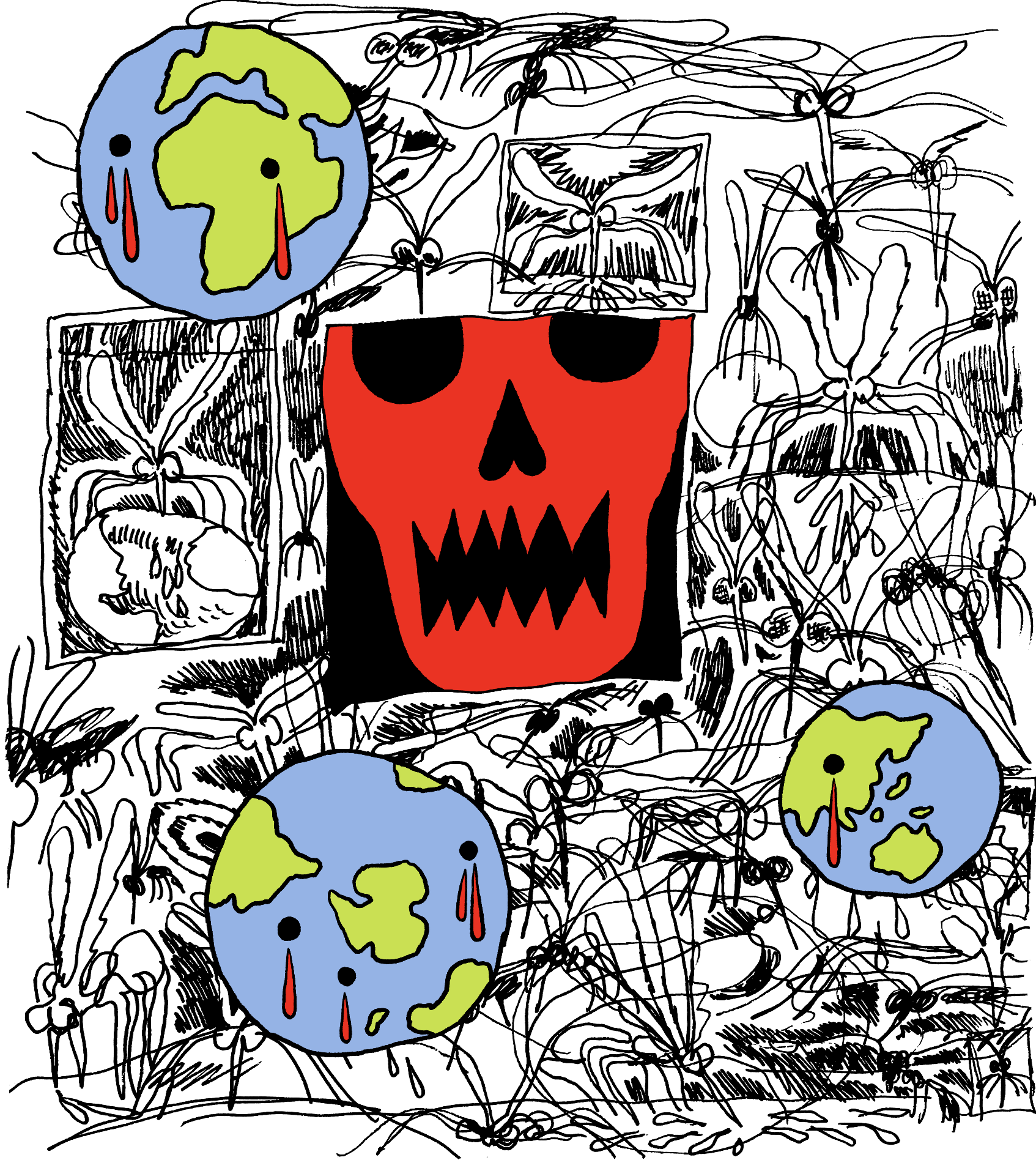
Artwork by Michael DeForge
The Prime Minister wears a T-shirt now. It costs 80 quid, and his jeans cost £295. The very nice Harrington jacket he’s often seen in costs £695. Looking like an ordinary bloke is expensive these days.
He’s apologised over Gaza too. He said that Labour “didn’t get it right” and “needs to do better”. It sounded like the British government was finally going to take a position on genocide. Even the climb down sounded a bit more radical than the days of Keir Starmer; “There’s increasing evidence that war crimes appear to have been committed.” But then he told us that it's not a matter for him to decide upon. Instead, it “must be for the international courts to determine, rather than politicians.”
Words matter. If the UK government declared that war crimes were being committed in Gaza, let alone a genocide, it would trigger a legal obligation to stop arms sales. The new policy then is to smile, apologise, and go on selling Israel the weapons, including components for F-35 aircraft, that it needs to continue its mass slaughter of an unarmed civilian population. Little appears to have changed at all. The sales of arms continue, and those who object to this are still arrested and charged under terrorism laws. It should come as little surprise from someone who has been a member of Labour Friends of Israel since 2015.
He also appeared alongside Volodymyr Zelensky at his first meeting with a foreign leader and assured him that the UK was 100% with Ukraine for as long as it takes. On the surface, the situation in Ukraine has similarities with that in Palestine. Russia invaded Ukraine and is committing atrocities there, just as Israel is in Palestine. The first difference is in the British response. Britain is 100% with Ukraine. In Palestine, it is selling Israel arms with which to commit genocide. That would be the equivalent of selling Russia bombs to commit massacres in Ukraine.
There must, then, be some difference between the two situations. It’s certainly not one of morality. The horrors inflicted by the Israeli army upon the civilian population have been far worse than those committed by Russia in terms of people killed. Why then is the UK 100% behind Ukraine, yet arresting people on the streets for saying that they oppose genocide in Palestine?
The answer lies not in the field of morality, but in that of geopolitics. Britain sees it as in its interests to support Israel. It also sees it as in its interests to support Ukraine. The dead have no voice in this. Nor is there anyone speaking up for any moral imperative. It’s national interests that speak loudest.
We should look at the causes of the war in Ukraine. This war is not the act of some ‘irrational actor’. Putin did not start this war because he is ‘crazy’. This war is part of a long struggle played out between America and Russia since 1945. It seemed that after 1989, Russia had been historically defeated in this struggle. Certainly, it suffered a huge defeat. The Warsaw Pact and even the Soviet Union itself were broken up. NATO and the EU expanded rapidly to incorporate many of the newly ‘independent’ states. Now, with America’s role as the single world power diminishing, Russia has seen its chance to reassert its power over Ukraine. It’s not some act of a single ‘madman’. It’s an expression of the interests of Russian capitalism. This is how imperialism works.
So in the midst of this struggle between two imperialist giants, Ukrainian workers are being asked to defend ‘their’ country, and in Britain everybody is being asked to back them. The great powers, as ever, are not clashing directly. This struggle is being carried out by a series of small wars, either between proxies or involving one of the major powers directly intervening in a country. We’ve seen all this before, in Korea, Vietnam, Afghanistan, and a host of proxy wars across the ‘third world’.
Workers in Ukraine are being rallied to this slaughter with all sorts of propaganda. Many of the slogans sound ‘left’. Both sides rally behind slogans of ‘anti-imperialism’. However, this is just a cynical ploy to rally the populace to die on behalf of one imperialism against the other. ‘Anti-fascism’ has become the rallying call of the warmongers on both sides. The West accuses Putin of being ‘worse than Hitler’, and the Russians accuse the Ukrainians of being Nazis.
Then we have patriotism. In times of war, nation-states always rely on patriotism. Russia is using it today, just as it did during the ‘Great Patriotic war’. Ukraine is using it too, calling on workers to defend the nation and freedom. In reality, this is a slogan of the rich. It is the rich who own the country. It is the rich who reap the products of workers’ labour, and it is the rich who stand to lose these things when their country is taken over by another. If Ukraine manages to survive this war intact, the rich will continue to make money, and hundreds of thousands of workers will have lost their lives. If Russia wins a victory and takes over part of Ukraine, hundreds of thousands will still be dead, and workers will still go to work to make other bosses rich, perhaps a little more exploited. But a victorious Ukraine would call for workers to make sacrifices for the nation, too. Is it really worth dying for?
And as for freedom, well, war always shows how illusory these freedoms are. In Ukraine today, adult men are forbidden from leaving the country, and gangs of recruiters snatch people off the streets. In Europe, there are moves towards returning male Ukrainian refugees of military age to die in the slaughter. Eleven political parties have been banned, including one major parliamentary party. People deemed insufficiently patriotic have been tortured and murdered. This is the ‘freedom’ that is being defended. We ask again whether it is really worth dying for. We say clearly that workers have no interest in defending the nation.
Today, hardly anybody takes a stand opposing the war. Most Europeans, while genuinely desiring peace, are parroting the propaganda of their own states. States that would show no hesitation in sacrificing their lives should it become ‘necessary’, and will show no hesitation in urging workers to make financial sacrifices for the nation and the economy. While it may be in the interests of the new government to support the war, it’s not in the interests of ordinary people. As the war goes on, and military spending increases, energy prices rise, and so does inflation; it’s ordinary people who are being asked to pay the costs of the war, both those dying on the front line and those in the West suffering economically. At home, it is pensioners and the poor who will bear the brunt of this, people who worked all their lives and can no longer afford to heat their homes. Andy Burnham himself will be warm in his £695 jacket.
Devrim Valerian is a member of the Bulgarian workers’ group Konflikt. When not hanging out at the beach, or writing articles, he teaches small children.
While you’re here- would you consider subscribing? Each quarter we print 50,000 copies, and our vendors keep 100% of the money from sales, meaning DOPE Magazine existing puts around £600,000 into the hands of our homeless vendors each year.
For every £1 put into the organisation through subscriptions, we turn this into £12 for our vendors. This means a year’s subscription to DOPE Magazine at £3 a month makes our vendors £432.
All funded by our community of subscribers.