
The struggle to remain Europe's last Indigenous people.
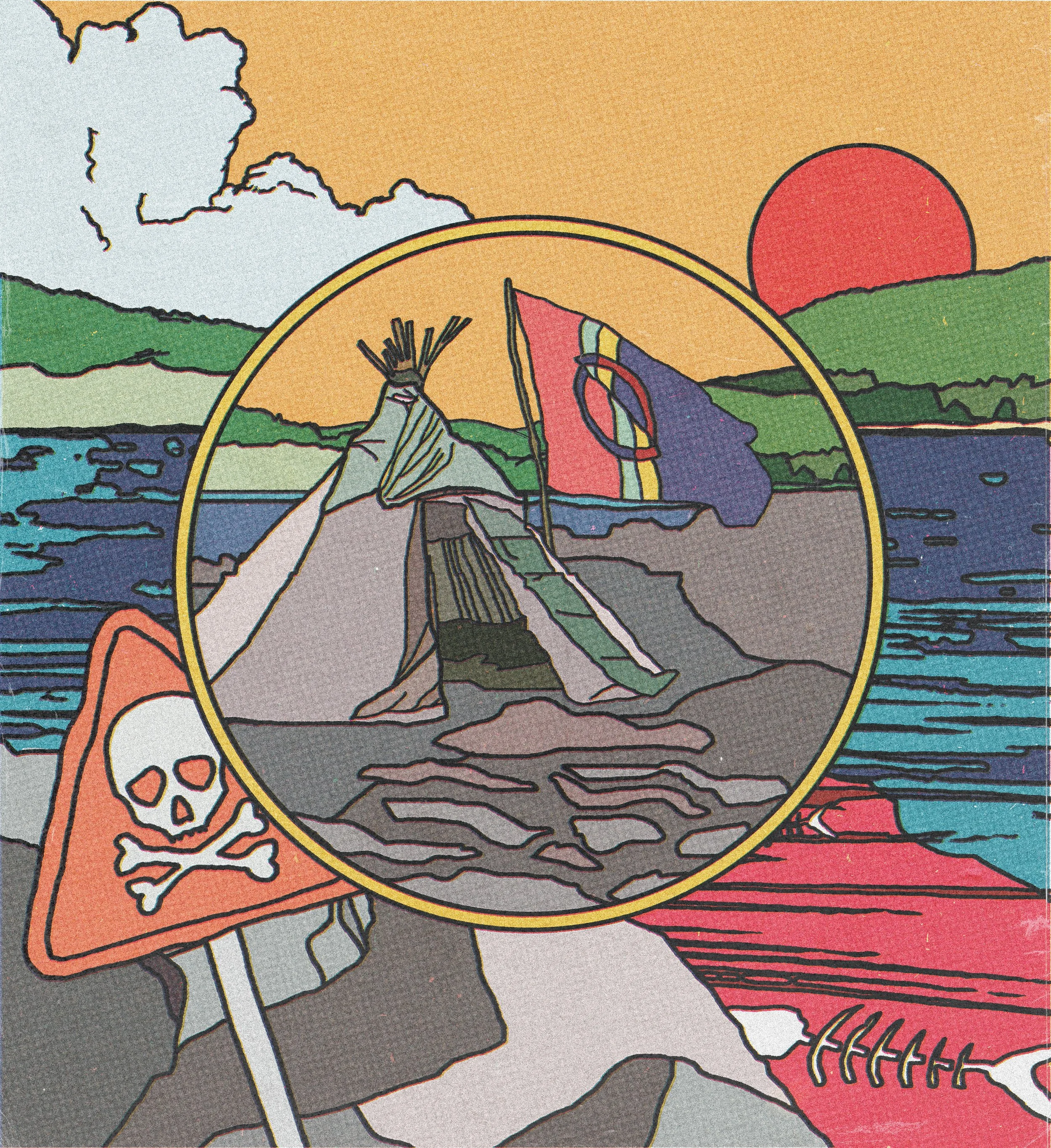
It is well known to many that corporations and states destroy Indigenous peoples' lives and lands across the Global South. Yet not as many people know about the Sámi, the only people in Europe with Indigenous status. They live in the northern parts of Norway, Sweden, Finland, and the Kola Peninsula in Russia. While the Nordic states have a reputation in Britain for being socially and environmentally progressive, they are outright repressive when it comes to Indigenous people. Norway, Sweden and Finland have committed systemic human rights violations against the Sámi, including forced assimilation and violent land grabs, as part of a continuous process of colonisation. Likewise, the Russian state and the Soviet Union also persecuted these Indigenous people, who are strongly bonded with reindeer and herding. As Hætta Isaksen, a Sámi from Northern Norway, tells me, "We have to work hard to shake the image that the Nordic countries are these kinds of human rights paradises."
The Nussir mountain slopes down to a fjord leading to the sea, not far from where the Atlantic and Arctic Oceans meet. It is a beautiful setting, but the land is being blown apart by mining. Despite the Sámi people actively resisting construction, various corporations and investors have attempted to build a copper, silver, and gold mine here since 2014. In late 2024, Canadian company Blue Moon Metals acquired the project, which threatens a mountainous reindeer calving area. The miners also plan to dump two million tons of toxic waste into the fjord annually – a vital spawning area for salmon.
Ella Marie Hætta Isaksen is a Sámi land defender, musician, and actor who uses her platform to push back against mining and protect Sámi rights. She has resisted the mine at Nussir since 2014. From June 2025 to February 2026, she participated in Norway's longest-ever direct-action camp. She explained to me that the Nussir mine is symbolic, as it not only threatens the reindeer, which are intrinsic to their lives, but also the Sámi who live in coastal areas by restricting their access to their traditional waters.
“Everyone needs to understand the connection Indigenous people have to their traditional homelands and the Earth. We aren't Indigenous without being able to live off the land."
Wind farms, mining, tourism, and NATO military bases; the Sámi are losing ever more land, a people divided by centuries of colonisation by the three Nordic countries and Russia. Climate meltdown – a direct consequence of colonialism – now also threatens their livelihood. For instance, one impact is starving reindeer, as snow now melts in winter, refreezes, and traps their main food: lichen.
Despite mining being carbon-intensive and dirty, and much mineral demand coming from destructive sectors such as AI and war technologies, the Nussir mine is marketed as a "green" project. Under the EU's 2024 Critical Raw Materials Act, it can bypass regulations, including Indigenous consent, and seek green funding. Each year, the EU will select more sites to receive these "green" incentives. Norway, as an EU partner, may see more mines gain this status across the Sámi homelands, touted as a mineral "treasure trove."
In 2014, when the mine was first proposed, there was no green justification for it. Now the justification is used a lot. "That is why the green colonialism term resonates very broadly with our people," Hætta Isaksen says. "Why do we have to move? Why our culture needs to be erased is always justified with different reasoning. But it's still colonialism. Both Norway and the EU will overlook international law and Indigenous rights when it suits them. That's why not only fighting for our rights but defending them is very important. International law needs to protect Indigenous peoples, as capitalist greed will take over at some point."
In 2021, the first direct action protest camp was established against the mine. At the same time that she was attending this protest, Hætta Isaksen was also playing the lead in Let the River Flow, a film about Sámi resistance to a massive hydro-electric project from the late 1970s and early 1980s. Those Alta protests, which occurred a generation earlier, had similarly united the Sami people in opposition to a project that would have flooded their lands, drawing a historic parallel to the current mine protest.
Hætta Isaksen says she will always look up to the Alta protesters, who were vital for reasserting Sámi pride. The impact of their actions manifests today in many ways, including the Sámi Parliaments, the resurgence of Sámi languages, and the celebration of Sámi culture. However, after speaking to elders involved in the Alta protests, she notes: "At the same time, everything was not fixed by that movement. Firstly, the dam was built. Also, the land grabs have just grown in numbers afterwards, especially in the name of green colonialism."
The Norwegian government fully owned Statkraft, the company behind the Alta dam. In contrast, today, global corporations partner with the EU and Nordic countries to profit from and plunder Sámi lands. This shift, Hætta Isaksen explains, is why she and other Sámi people increasingly take their struggle to those backing the mine. Their actions include protests outside European Union buildings and at the offices of Hartree in many countries, an investment company involved in the Nussir mine. Notably, in 2021, protests against the previous mine owners, Aurubis, successfully pressured them to divest from the project.
The struggle against the expansion of mining is taking place across many spheres. This resistance ranges from direct action in the Arctic to street protests and numerous cases. The Norwegian Supreme Court will soon decide whether Norway can be one of two countries allowing miners to dump toxic tailings into the ocean—a practice legal only in Papua New Guinea. Meanwhile, international groups such as the SIRGE Coalition, Amnesty International, and Movement Research Unit work in solidarity with the Sámi against mining.
"Building allyship across the continent is important to show how everything is connected, and how minority and marginalised groups are so invisible in the international political game played at Brussels and different places," Hætta Isaksen stresses. "We cannot stand against this inhumane pressure on our lands alone. We've received a lot of solidarity, but there is still a long way to go. For me, it's an important message that we can all take on fights that we were not born into."
She adds that it was a fellow activist who made her realise that broader resistance is necessary to challenge the money and power of capitalists: "They work together to dominate us and win all these small battles, but all together that will destroy ecology and nature. To stand a chance, we're going to have to lean on each other, each other's experiences and each other's numbers. We need to show up physically on the streets for each other."
Ella Marie Hætta Isaksen participates in Natur og ungdom, a Sámi and majority-Norwegian organisation that co-organised the direct action camp. You can find more information about the struggle against the Nussir mine on their website www.nu.no/repparfjord-english
Steve Rushton is a writer and activist currently pursuing a PhD about the Sámi resistance against green colonisation and the expansion of mining.
While you’re here- would you consider subscribing? Each quarter we print 50,000 copies, and our vendors keep 100% of the money from sales, meaning DOPE Magazine existing puts around £600,000 into the hands of our homeless vendors each year.
For every £1 put into the organisation through subscriptions, we turn this into £12 for our vendors. This means a year’s subscription to DOPE Magazine at £3 a month makes our vendors £432.
All funded by our community of subscribers.