
Spain in 1936: Building Self-managed Socialism From Below
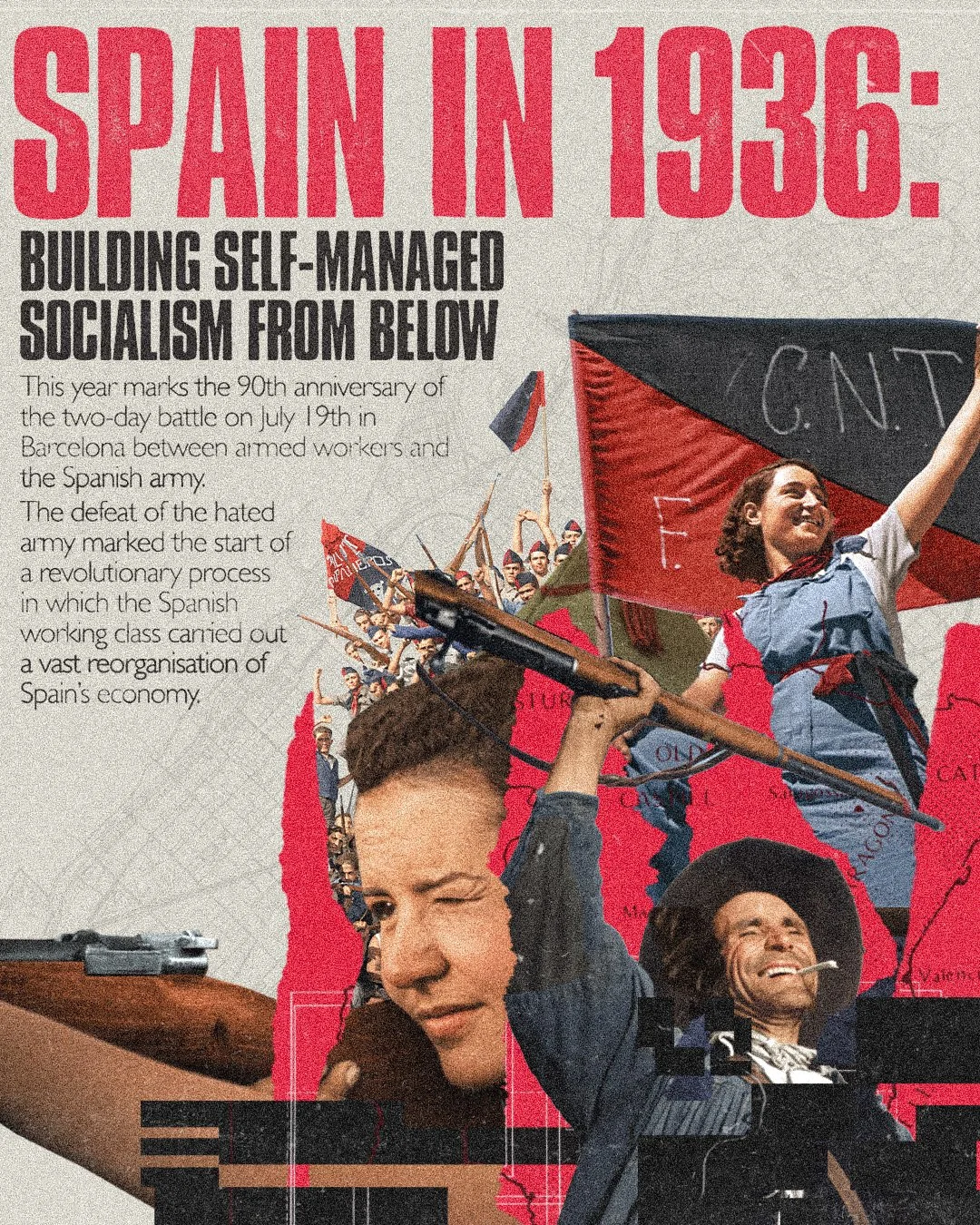
The unions of the National Confederation of Labour (CNT) were the driving force in this process. The basic units were the workplace “sections.” Member assemblies and a council of elected shop stewards ran these sections. The shop stewards were the organic worker leadership who kept the union in sync with the rank and file. The various shops in a local industry were united into a local industrial union. An elected committee of union secretaries managed various tasks, including supporting imprisoned members and coordinating with local social movements. The local unions in a city or area were united into a local federation—“one big union”—to facilitate class-wide mobilisations, such as general strikes.
The CNT unions gave anarchists a way to connect their radical ideas to the concerns and grievances of working-class people. The CNT movement extended outward to the networks of anarchist groups, publishing efforts, the network of storefront worker schools, and the women’s liberation organisation Mujeres Libres. The movement operated with a concept of capacitación — building the capacity to act as an active participant in the movement. Thus, the storefront centres provided cultural events, study groups, and classes on public speaking.
For CNT militants, the goal of the revolution was socialization. In the first phase, all the workplaces in an industry would be grouped together into an industrial federation. This federation would coordinate that industry. The actual takeovers of workplaces came from the union’s rank-and-file leadership—shop stewards, union secretaries, and worker militia groups.
The second phase of socialization would be a society-wide unity of these industry federations. This would be coordinated through meetings of delegates called “economic councils.” Joan Ferrer was the secretary of the Commercial Workers Union in Barcelona. In a 1970s interview, he described socialization as follows:
“It was our idea in the CNT that everything should start from the worker, not — as with the Communists — that everything should be run by the state. To this end we wanted to set up industrial federations — textiles, metal-working, department stores, etc. — which would be represented on an overall Economics Council which would direct the economy. Everything, including economic planning, would thus remain in the hands of the workers.”
CNT militants first expropriated all the companies in an industry. They then merged their assets into the industry federation. The furniture, railway, maritime transport, public transit, health care, entertainment, haircutting, dairy, textile, fishing, and arms industries were among those socialized.
The CNT wood workers federation seized the logging operations and sawmills in the Pyrenees mountains, as well as furniture retail stores, large furniture factories, and small independent cabinet-making shops in Barcelona and Valencia. The CNT union shut down the small cabinet-making shops, where conditions were often cramped, inefficient, and dangerous. As a wood union member recalled: “The concept that prevailed was that the working class should have good furniture at cheap prices.”
To take another example, the Ebro Light & Power monopoly was converted into a utility federation. It was run by an elected eight-person worker council. In that industry, about half the workers were members of the socialist party union, UGT. Thus, the workers' council had four CNT delegates and four UGT delegates. Under worker control, the electric power system was expanded, with new hydroelectric generators installed in the Pyrenees Mountains.
Another achievement was the creation of the first socialized health care system in Spain’s history. The CNT health federation was an industrial union that ran hospitals and dental clinics and took over drug manufacturing. In the first year the health workers federation created six new hospitals. Visits to the new network of outpatient clinics were free. Many unions, collectivised industries, and village collectives entered into agreements with the health union to provide free health care for their members and their families.
Spain had a thoroughly capitalist agricultural system in which rural wage workers were hired by landlords. The CNT and UGT farm labour unions thus cooperated in the seizure of these lands — collectivising 2,000 villages and 14 million acres of farmland.
The CNT’s “libertarian communism” program advocated free provision of services to meet needs such as health care. But their program also included a commitment to the principle of equal pay per hour of work. Pay was equalised in some industries, such as the railways. Women were the lowest-paid and benefited the most from this policy.
The main problem the CNT faced was how to deal with the state. There were differences of opinion on this. The majority view favoured joining the official state bodies to obtain assistance in building a war industry and coping with the severe economic crisis caused by the civil war.
Beginning in late August, an alternative view emerged. CNT journalists and militia militants began to push for replacing the Republican state with a union governing council to run a unified popular militia. This would consist of an equal number of CNT and UGT delegates. They negotiated with the prime minister, Largo Caballero (also head of the UGT), but he vetoed the proposal. During the negotiations with the UGT for a National Defence Council, Eduardo de Guzmán was editor of the daily CNT paper Castilla Libre in Madrid. Looking back from the 1970s, de Guzmán says that at that moment it was possible to create “a proletarian government—total working-class democracy in which all sectors of the proletariat—but of the proletariat alone—would be represented. To make a revolution, power must be seized.”
The CNT was part of the International Workers Association (IWA), and the IWA’s 1922 principles state that workers' unions need to control the dominant armed power in a revolutionary situation. A union governing council running the militia army would put that into practice. The CNT had worked along these lines after the defeat of the Spanish army in Barcelona. Over a period of some weeks, the CNT built a “proletarian army” with about 100,000 members.
After the CNT militia was absorbed into a rebuilt conventional army in late 1936, the rebuilt Republican state and a new national police force posed a threat of state takeover of industries, eliminating worker control. From April 1937 on, the communist-controlled police were used to seize and nationalise certain industries — such as the arms industry and the telephone system. Communist-controlled army units were used to smash the elected Defence Council in rural eastern Aragon — elected by the village assemblies.
The military aid provided to the fascist leader Franco by Hitler and Mussolini was key to the military defeat of the anti-fascist forces in the civil war. The geopolitical isolation of the revolution in Spain was another problem. If multiple revolutions had been occurring at that time, Hitler and Mussolini would not have had the resources to stomp them all out.
Nonetheless, building democratic worker self-management of an entire economy — and building a “proletarian army” to protect the revolution — was an incredible achievement. Their achievement speaks to us today because it provides a model of socialism that rejects the state-managerial class schemes of Marxist-Leninists and other state socialists. ¡Viva la Revolución!
Tom Wetzel has written on labour history, worker struggles, libertarian socialist ideas, and housing struggles since the 1970s. He is a member of the East Bay Syndicalists Group.
While you’re here- would you consider subscribing? Each quarter we print 50,000 copies, and our vendors keep 100% of the money from sales, meaning DOPE Magazine existing puts around £600,000 into the hands of our homeless vendors each year.
For every £1 put into the organisation through subscriptions, we turn this into £12 for our vendors. This means a year’s subscription to DOPE Magazine at £3 a month makes our vendors £432.
All funded by our community of subscribers.