
THE use of ai in war, from ukraine to palestine.
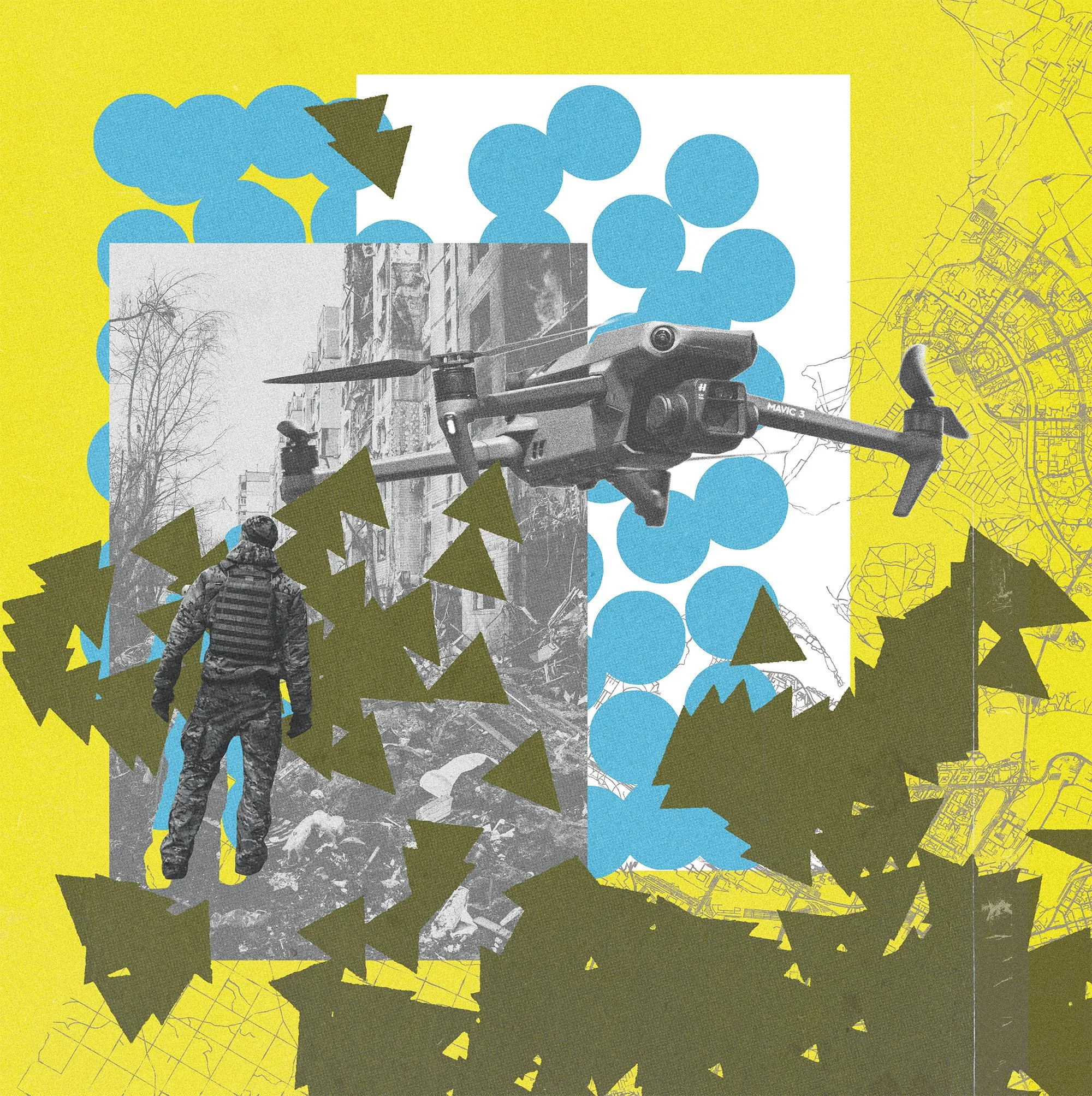
War as we know it is changing - and fast. Sections of the Ukrainian front line are now manned entirely by drones, with unmanned ground vehicles (UGVs) taking the place of human soldiers in the ‘kill zone.’ With drones accounting for 70-80% of battlefield casualties in 2025, a future of ‘coordinated drone swarms executing missions autonomously’ is within arm's reach, says researcher David Kirichenko.
The death toll in Ukraine is staggering. Some reports put the Russian state's casualty rate at 30,000 per month, with 450,000 deaths and 1.4 million casualties on the Russian side. Meanwhile, on the Ukraine side, the state puts it’s fatalities at 50,000, but some estimates run as high as 150,00- with 625,000 casualties. A big part of this is down to disparity in drone technology, which the Ukrainian state has taken a clear lead over Russia recently. The Ukraine war might feature more robots than human soldiers in the near future - ‘months, not a year,’ as predicted by one Ukrainian commander. Increasingly, the horrors of the battlefield are confined behind a screen. With companies such as Anduril quickly incorporating AI into weapons systems, it may not be long until even the operation is automated, despite assertions from leaders that human control will always be retained. It’s been described as the ‘Oppenheimer moment of this generation.’
This technological progression can appear as a double-edged sword. On the one hand, these developments enable greater asymmetric warfare, with much weaker forces able to hold their own against states with multi-million-pound technology budgets. But for the future of humankind, no major advance in military technology is ever truly a win. This isn’t just a step ahead in the Ukraine war - it’s also a step closer to an entirely gamified, dehumanised world where death is seen but not felt.
War already erodes so much humanity. How much easier is it to lose sight of the sacredness of life when you don’t even have to make contact to end it? The disconnect isn’t the sole problem - it’s already being seized upon for capitalist gain, with terrifying implications. In a Channel 4 investigation, one reporter delves into the points system available with a weapons manufacturer, which he frames as ‘lethal loyalty cards’ - a scheme in which army units can get points for winning manoeuvres in the field, and exchange these points for products. The commercialisation of warfare is by no means new, but we continually reach new levels of grotesque horror. Combined with the Kremlin deploying tactics that blatantly sacrifice their own manipulable recruits for minor gains, the result is death on a scale not seen in a war since WW2. The development of a state of warfare in which colossal death tolls can be achieved from a console room inspires little hope for the future of humanity.
And what of the conflicts where this technology doesn’t level the playing field, but rather exacerbates the disparities? What about those who earn points not even for material gain, but simply for psychopathic enjoyment? In Gaza, IDF soldiers are ranked and rewarded on the Blue Wolf mobile app for capturing the most Palestinian faces, which they identify and match with a central database - reportedly sometimes by holding Palestinians up to CCTV cameras. It’s one thing to fear that gamification will erode people’s humanity through abstraction and incentive. It’s another to realise that this sense of humanity may take next to nothing to crumble. We already live in a world where algorithm Lavender decides which Palestinians live or die, with IDF soldiers deferring to its judgement and often approving its AI-generated targets without even checking them themselves. This is an algorithm that applies a ‘collateral damage threshold’ of up to 20 civilians per strike, accelerating brute force rather than reducing it. The terrifying world defined by robotic control over life and death isn’t in the future. It’s already here, killing those born into the most merciless of circumstances.
There are infinite speculations about what warfare is rapidly evolving into, and few of them are positive. Of course, the idea of all conflicts being fought entirely between drones at first sounds great. The destructive effects of elite disagreement are offloaded onto robots rather than the working class. Fewer people die. But, at the same time, war never ends. Untenable personnel losses force surrender, and this can’t happen when there is no one on the field. Wars will drag on until total resource exhaustion.
If human involvement is minimised, new risks arise. Disconnection from destruction is not the absence of it. Without immediate human cost, destruction is much more likely to run on unconstrained, increasing the longevity and environmental damage of war. Kirichenko describes the results of the increasing use of UGVs as ‘a new kind of no man’s land,’ a danger zone filled with ‘semi-autonomous drones’ built to kill anything they detect. Alongside the potential for the creation of endless wastelands, it’s not difficult to envision perpetual destruction running rampant, especially as more and more autonomy is granted to machines.
It’s already known that the use of drones makes it easier for leaders to justify entering a conflict, because of the lower domestic risks and purported ability for ‘targeted killing’. Military action is already approved more easily because of these tools. It’s not long until the tools themselves decide the course of action. This would be less concerning if we assume in this scenario their primary target is other drones, but this isn’t truly likely. As aforementioned, losses of machinery isn’t likely to end a conflict - loss of personnel and decimation of morale is. Thus, it’s unlikely that humans will ever truly be removed from the equation of war. As we’ve seen in Gaza, just because soldiers might die less, this doesn’t correspond to fewer civilian deaths. And with algorithms ever more dominant in this scenario, the potential for mass slaughter is actually compounded.
This isn’t a doomerist conspiracy that the robots are going to take over - it’s less outlandish, and much more insidious. Already with the IDF AI, Lavender, we have seen a willingness to concede decision-making. Proponents of the automation revolution insist that a human will always be kept in the loop of the decision-making, but what if they don’t even want that duty? What if that spot becomes purely tokenistic, and AI monopolises the role of deciding who to kill, as has already been seen in Israel? It is not human impact that we are likely to see eradicated - it is human responsibility.
Moreover, as with every instance of a dominant new technology, another question remains: who owns it? Most of the drones in Ukraine are fitted with Elon Musk’s mini Starlinks. Asked if he trusts Musk, a Ukrainian operator responds ‘right now, I can’t not trust him.’ It doesn’t take much to see why allowing technology owned by a technocrat with a fragile ego to monopolise warfare may be a bad idea. Trump holding Starlink over Ukraine’s head in mineral negotiations was not so long ago. By the time this article is published, a rogue piece of space debris Musk’s SpaceX lost control of will have spiralled into the moon. These are the men who will have the programmes behind automated warfare in their fists. Reassuring claims that warfare is becoming more controlled and humane fall deaf to many ears.
If drones ultimately lead to fewer deaths on frontlines, it's a welcome change. But these developments will never be limited to saving people. Already, automated warfare is being used for horrific measures, and making a game out of it as it goes, but it’s only a game for the winners. Assertions that these measures will make conflict more humane don’t stand, logically or empirically. There will always be losers in this game, paying with their lives.
While you’re here- would you consider subscribing? Each quarter we print 50,000 copies, and our vendors keep 100% of the money from sales, meaning DOPE Magazine existing puts around £600,000 into the hands of our homeless vendors each year. ⚡
For every £1 put into the organisation through subscriptions, we turn this into £12 for our vendors. This means a year’s subscription to DOPE Magazine at £3 a month makes our vendors £432.🔥
All funded by our community of subscribers. ✨
Subscribe to help us print even more! 👇