
Public Nuisance or public resistance?
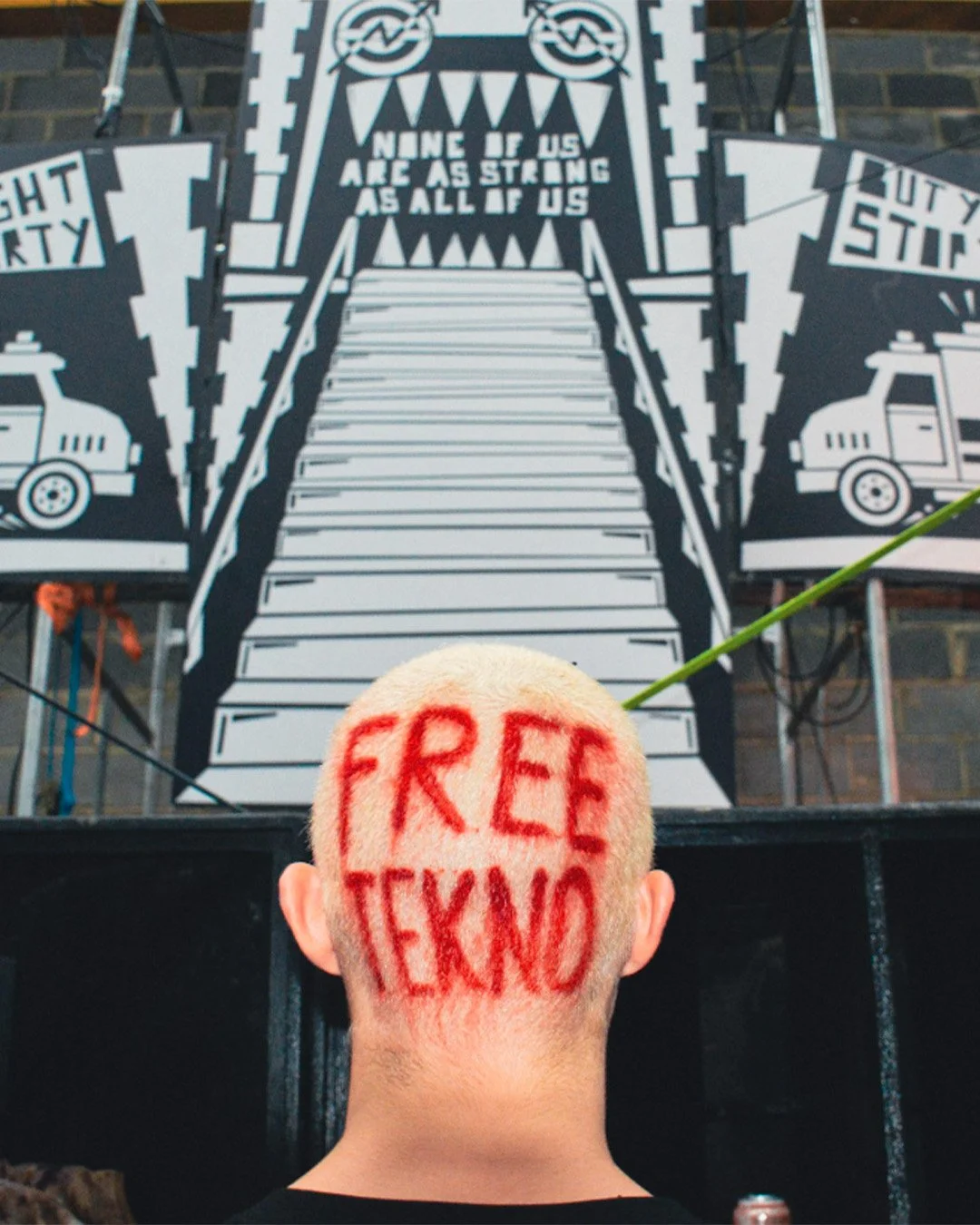
By Shaun English. Photo: Faye Maraghe
As authorities crack down on London's free party scene, the ravers pushing back say that resistance is the point.
What comes to mind when you hear “public nuisance”? You might think of loud music, illegal parking, trespassing, and public intoxication. These acts can be crimes and may cause a local news stir, but most people dismiss them in favour of reading about a politician’s latest blunder or a businessman in an ill-fitting suit. Yet the scale changes dramatically when thousands form a wall by the only entrance to a warehouse in East London for two hours, preventing police from shutting down one of the year’s biggest illegal raves. Suddenly, the question of what constitutes a public nuisance becomes political.
Many in the UK's free party scene describe hosting events in London as “carnage”. It may not look like it at first. Derelict buildings and abandoned warehouses—ironically left vacant by sluggish bureaucracy and neglectful councils—become the venues. Those same people who dismiss these events have left tons of prime real estate. An expanding community of London ravers is hungry for an escape, a boogie, a release from surviving in the city. With all this, outsiders might expect windows shattering across the city, serenaded by hard techno. But windows aren’t being blasted in warehouses, but in soundproof venues and clubs, where a single vodka coke costs £12, bowed down by council permission, increasingly strict venue licensing bureaucracy, and of course, the slithering market tentacle. It is simply too hard for many. In contrast, squat parties- where DJs don’t require payment, and can pop up in a variety of places- are seen by many as an alternative.
Squat parties are held as large as possible to make it harder for police to shut them down and prevent equipment confiscation. In London, police can arrive within minutes of the location being revealed. Compared to countryside free parties, there is a higher risk in London of hosting a squat party just for the weekend. That is why most squat parties in London take place in existing, long-standing squats with experienced security.
“On the night you set your rigs and everything that's going to happen, and then drop the location. By the time all the people have come and all the police have come it's the night time so all the courts are closed, so they have to wait til the next court is opened to get an official warrant because of squatters rights (Section 63: squatting in non-commercial buildings is generally not considered to be a crime, but will be treated as a civil matter), so that protects us from them being able to shut down the party. When it gets to a certain number of people, they actually know that it is more dangerous to shut this party down and disperse people across the streets than it is to let the chaos and the carnage die down naturally.”
An example of a recent large squat party is London’s Calling, which took place again in February this year. It is a project built by more than ten different rigs, with many smaller crews, individual contributors, artists and organisers across the UK - all part of one big network where everyone shares and borrows equipment. The first event in January 2025 drew more than 1,000 people, prompting the organisers to host a larger event the following year.
Ravers come from all kinds of scenes - old-school squatters, industrial techno, D&B, nightcore enjoyers, even cosplayers, hippies, and Hackney moustaches. All of them for a chance at a free boogie in one of the biggest mixes of ravers, all becoming one in a massive festival of colour and music.
Those behind the scenes recognise the danger of hosting these events, but they love the game and see their actions as part of creating change against an establishment that has failed them. Many organisers cite the government's arrest and ostracisation of their peers as a big motivation, as well as a more general repression of a generation’s liberties and free will.
“It's a fuck you, and a statement that we’re here, and we have more power than you, and this is what the people can do. It can not be that great an event, but it is still successful to us because it still causes an upset to the police, and it can still cause a disturbance in the world. As long as you have made noise and made a stance and have something that’s going to end up on Keir Starmer's desk in the morning, then that's successful.”
Whether all ravers see it this way is debatable. Many ravers are mainly there for a quick and cheap dance, and like the looser restrictions which squats and free parties provide. Critics would argue that an unregulated rave puts people in danger, with security concerns, neighbourhood disruption and drug possession as the main reasons for the arrest of organisers. But in many ways, that’s the point of going to an illegal rave. Most young ravers are aware of why free parties and squats are there, through personal experiences, and that of their friends, peers and neighbours, or the statistic that says that 1 in 50 people are homeless or in emergency homes in London. It is evident just by stepping outside and having a walk in the area. Many people are being targeted and shunned by the police, and economically, due to the lack of opportunities to break the cycle. For many, being part of the disturbance is not just an escape from the increasingly untenable and unacceptable condition in which people find themselves, but a chance to actively push against this condition and its downward trajectory.
“We all know the truth that they’re all money laundering elites. They’ve got police who are on a payroll (and we’re not). It's a horrible system which we’re made to believe is the right way of life, and I think the free party system speaks out against it, it's anti-capitalistic, and it's anti fascist, and it will always be political, throwing squats, especially to the level which we’re doing.”
Unfortunately, a statement by the organisers revealed that London’s Calling will not continue in London in the future, due to security and safety concerns arising from a few ravers who arrived with “ulterior motives” that do not reflect the organisers' intentions. But safety concerns are sometimes not caused by ravers, but by police. A good example of this was in April, when Dorset police shut Eggtek 2026 down due to “significant disruption in the community” and, ironically, their own “safety concerns”. They came down in riot gear, complete with dogs and shields.
Pictures circulated on social media immediately, including a harrowing photo of a bloody man surrounded by riot police with batons. There were also many more videos of police aggressively pushing into a crowd. It is reported that many people were taken to the hospital, and ravers at the event have described being there when the police came as “traumatic” and “terrifying”.
Mainstream media and publications framed the event with the usual “unlicensed” and “unregulated” jargon, and police covered it all as “violent and hostile”, completely unsympathetic to those injured and justifying police brutality. The public outrage within the community has led people to be even more determined to stand up to the police and the establishment. Whilst raves are now just labelled as a public nuisance, the resistance only grows the more the authorities push against it.
Shaun English is a London-based journalist, specialising in grassroots music, arts and culture.
Each issue we print 40,000 copies, worth £120,000 to our vendors. Your £3/month subscription is used to print 30 copies per issue, worth £90 for our vendors. We went from 1000 copies per issue in 2018 to 40,000 per issue in 2026. The only thing stopping us from doing more is money. With your support, we can go even further. Help us print and distribute more copies for free to anyone who wants to sell it by becoming a monthly subscriber.