
One more method of keeping us in line. One more party called Green this time.
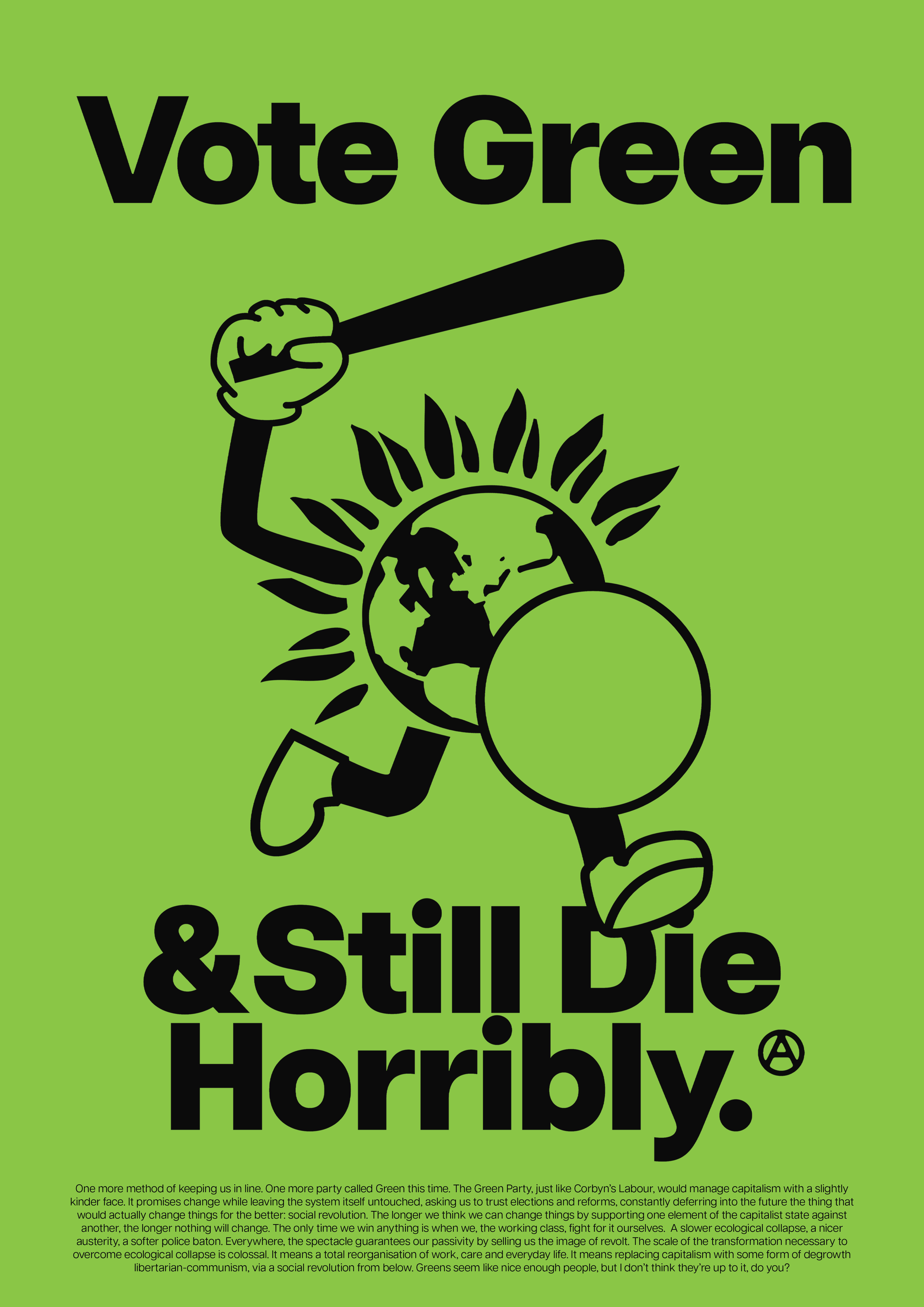
By Sian. Illustration by Rory Robertson-Shaw.
For the third time in a decade, the British left has found its saviour. First it was Corbyn. Then it was Corbyn again. Now it's Zack. He's got a rent control policy and a TikTok strategy!
The lefties have a new golden boy. Flanked by articulate mancunian plumber Hannah Spencer, Zack Polanski’s Greens have, within a very short time of his leadership election, gained control of 5 more councils, won a by-election and increased their membership to over 200,000. In some polls, the Greens have even overtaken Labour. Polanski is media-savvy, combative, and willing to argue back against reform. He talks about cost-of-living issues and relates this to inequality and climate change. The Greens now seem like a serious political force, capable of taking a significant number of seats in the next general election from the Labour and Reform voter base, rather than being seen by most of the country as hopeless middle-class tofu-eating do-gooders.
This song sounds familiar. Que the slow chant of “oooohhhh jjjeerremmmy Cccooorrrbbbyyynnn” to the theme of the white stripes seven nation army at every single music festival in 2017. But as we know, instead of the People's Republic of Islington North taking power, we had Keir Starmer cancelling the £28 billion green investment pledge, cutting benefits for disabled people, selling weapons for the Israelis to carry out genocide, and a resurgent far-right street movement which threatens, via Reform, to take power. But don’t worry, because this time it's different, this time, Zack Polanski is going to sort everything out.
The state is not neutral.
Green Party politics, like Corbynism before it, has to pretend something that just isn’t true. That the state is a neutral instrument, that different political persuasions can pick and use as they would like. But this isn’t how the state works- its primary structural function is to maintain order for capitalism to continue to work. This matters for Polanski's greens because the institution he is trying to capture was not built for the purposes he wants to use it for, and will actively resist those purposes. What would have happened if Corbyn had actually won in 2017? In the weeks and months following a Corbyn government, in all likelihood, the pound would have tanked. This is because capital is mobile and answers to no electorate, and most importantly, knows how to send a message. The press would have gone into full overdrive, and the Bank of England Treasury would be in Corbyn's office, telling him exactly what the European Central Bank had told Alexis Tsipras and Syriza in 2015: moderate, or the money doesn’t work. And moderating means changing nothing; just like Syriza, who went on to enforce even more austerity, or Mitterand's government in France in 1981, which lasted 2 years before doing a complete U-turn.
Maybe Corbyn might have succeeded in passing some radical policies, not by getting his image right or managing the press better, but by having an organised movement outside of parliament capable of pushing his program through. For instance, unions ready to strike against the inevitable capital flight. Workers prepared to occupy workplaces to prevent closure. A street movement that would be ready to riot and control areas, making backing down more dangerous than pressing ahead- parliament being a ratification of something that was already happening in workplaces and the streets, rather than the thing itself.
This is what happened during Allende's socialist government in Chile: in response to factory owners leaving with all the investment, workers took over the factories and kept the government alive. Ultimately, a pact between the ITT Corporation, the CIA and Chile's military bombed the presidential palace, killed Allende, overthrew his government, and installed a fascist Junta. During Corbyn's time, a serving general reportedly said that the army would “take direct action” if Corbyn became prime minister, and MI5 ran files on Corbyn for decades. To see how this scenario might play out, it's worth watching the Channel 4 series “A Very British Coup”, in which a left-wing Labour leader is brought down by a coalition of MI5, newspaper magnates and the civil service. Whilst it's a work of fiction, the events it shows are very believable if you know the British state.
Feeling green
But back to the Greens. The Green's program is all very nice. It proposes a windfall tax, green investment, and retrofitted homes. A slower ecological collapse, a nicer austerity, a softer police baton. It doesn’t even get to the starting line of what is needed. The scale of the transformation necessary to overcome ecological collapse is colossal. It means a total reorganisation of work, care and everyday life. It probably means everybody is only doing 10-15 hours of work a week, and turning all the office blocks into community launderettes, communal kitchens, vertical gardens and housing. It means abolishing the growth imperative and ending an economic system that requires infinite growth on a finite planet. In short, it means replacing capitalism with something else entirely. In contrast, implicit in every green policy document is roughly the same people as now, but with better institutions and stronger regulations, even if many Greens might say they want a completely different system. And all this implies that the British ruling class and state would even let this more wholesome, nicer version of capitalism happen, which is debatable. Polanski promises change while leaving the system itself untouched, asking us to trust elections and reforms, constantly deferring into the future the thing that would actually change things for the better: working-class power and social revolution. The longer we think we can change things by supporting one element of the state against another, the longer nothing will change. The only time we win anything is when we fight for it ourselves.
The NHS didn’t come about primarily because of the ‘radical’ Labour government. It came about because a large number of military personnel returned from the war and began occupying old army barracks for housing, and the ruling class had to choose between granting some concessions to the working class or facing revolution. Whilst Attlee signed the legislation, he was downstream of the forces that made his policies possible.
The system rewards what is containable and marginalises what isn’t. If you give people a charismatic candidate to canvas for, they’ll spend less time building the thing that could actually make a radical government possible. Working-class power and neighbourhood power. Making the working class so powerful that any government, whatever their political stripe, has to listen to us, and there are consequences if they don’t. Of course, movements are ecologies. So by all means, vote Green: reformists and revolutionaries do not need to be enemies. But we need to be honest about what electoral politics can and can’t do. A Reform, Labour or Conservative government would certainly be worse in many ways. The threat of a Nigel Farage premiership is very real. But don’t think that voting for the Green Party is the silver bullet to save us.
Sian is an anarchist-communist from the south-west.
Each issue we print 40,000 copies, worth £120,000 to our vendors. Your £3/month subscription is used to print 30 copies per issue, worth £90 for our vendors. We went from 1000 copies per issue in 2018 to 40,000 per issue in 2026. The only thing stopping us from doing more is money. With your support, we can go even further. Help us print and distribute more copies for free to anyone who wants to sell it by becoming a monthly subscriber.