
The General Strike:
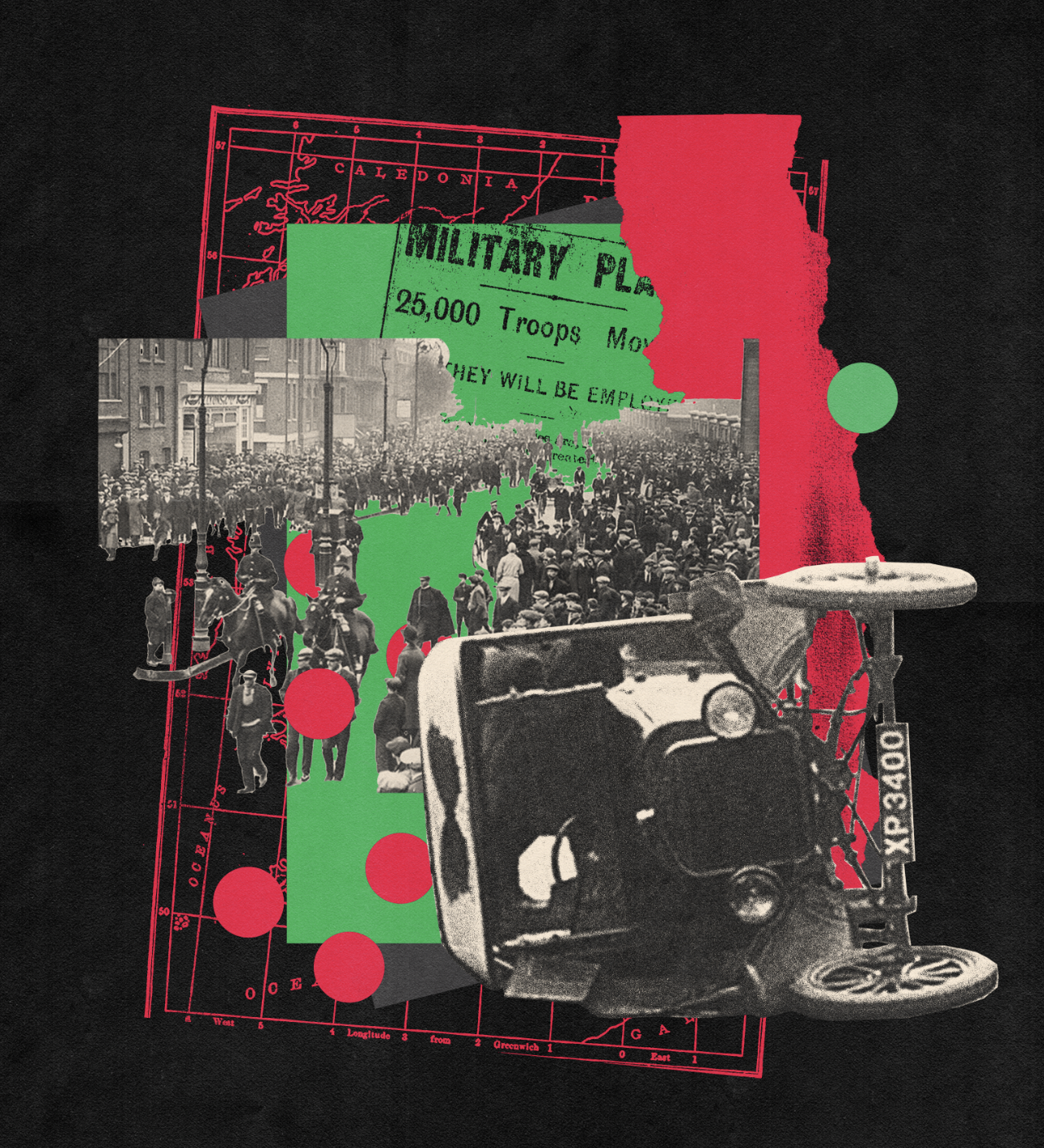
By Matthew Lee & Callum Cant. Illustration by Rory Robertson-Shaw.
One hundred years ago, two million workers joined Britain's largest-ever general strike. They faced up not just to their bosses and the government, but also their own union leaders. For over two weeks, this momentous event shook the very core of Britain.
The Origins of the General Strike
In 1817, William Benbow, a self-educated shoemaker, was released from prison after participating in a failed insurrection. He looked to formulate a new revolutionary strategy, which he called the "Grand National Holiday".
He toured the country for years promoting his idea. Then, in 1842, Staffordshire miners initiated a strike. They demanded not just better pay, but also political representation. Eventually, 500,000 workers across the country would join them, before it was crushed through a combination of military repression and lowered food prices. The first General Strike on earth had been defeated.
Following this defeat, craft unions that excluded unskilled workers dominated. Rather than fighting their bosses, they often tried to work with them. They built large financial reserves, and soon trade unions were more likely to be led by top-hatted officials in London than Staffordshire miners. A new organisation for these bureaucrats to coordinate with each other was formed: the Trades Union Congress (TUC).
The Triple Alliance
Unskilled workers continued to be pushed by their bosses to work faster, longer, and harder for less money. In the summer of 1888, unwilling to take it anymore, they erupted. Women working at the Bryant and May factory walked out against deadly conditions. They won, and were quickly succeeded by tram drivers, gas stokers, and dockers.
New general unions were formed, and over the next decade, union membership increased from 750,000 to 2 million. Whilst many top-hatted union officials remained, the rank-and-file of workers at the bottom countered them, organising unofficial strikes when their union leaders refused to endorse action.
They also agitated for a “Triple Alliance”: an agreement among the industrial unions to strike in support of one another. The union leaders, wanting to put their members back under their control, eventually formed such an alliance. Secretly, however, they hoped that its threat alone would prevent them from actually needing to follow through.
Black and Red Friday
In 1921, the mine owners announced pay cuts to offset declining profits. Miners called on the Triple Alliance for help; however, on 15th April, the unions announced they would not call a strike in support of them. Deemed “Black Friday”, the miners were eventually forced to accept the cuts.
By 1925, mine owners, with the government's support, again proposed further cuts to miners’ wages. However, this time, the TUC, under pressure from its rank-and-file, remained steadfast in its decision to call out its members for a general strike against this. The government backed off and agreed to subsidise miners' wages for nine months. Workers celebrated, proclaiming it “Red Friday”. But for this government, this was no defeat: they were simply buying time.
The 1926 General Strike Begins
The government spent the next year drafting a series of plans to deploy the military, police, and middle-class volunteers to break any future general strike. On the other side, union leaders did little. In fact, they were keen to avoid such a dispute altogether.
With the miners' subsidies soon to run out, the TUC began negotiations again with Prime Minister Stanley Baldwin. They begged for any sort of compromise. But this time the government was convinced to see their position through. The miners’ subsidies ended, and, refusing to work for lower wages, they were locked out of their pits.
Yet the TUC still refused to call a General Strike. Then, on 3rd May 1926, rank-and-file printworkers at The Daily Mail pulled the trigger. They refused to print an anti-union front page, and Baldwin cut off negotiations with the TUC, calling it an attack on free speech. The TUC was left with no option. The General Strike was finally on.
Not a penny off the pay, not a minute on the day!
The TUC only called out certain industries to join the miners: railways, docks, printshops, drivers, and iron and steelworks. However, many workers in industries not officially called out by the TUC still walked out on that first day. They mobilised under the slogan “Not a penny off the pay, not a minute on the day!”
The government, however, also moved into action. They put into action a shadow structure of special constables and middle-class “volunteers” to break the strike. This was led by a secret government body called the "Organisation for the Maintenance of Supplies", led by a group of admirals and aristocrats that incorporated entire bodies of organised fascists into itself.
Mass pickets managed to stop many of these “volunteers” from breaking the strike. In the docks, navy ships were used to transport middle-class scabs under the cover of nightfall. They worked under siege conditions, unable to leave the docks due to the pickets, sleeping on the destroyers brought in to guard them. Many, however, were useless: lacking practical experience, their incompetence often damaged the very machines they were meant to be working with.
Both the government and the TUC produced competing daily bulletins, respectively the “British Gazette” and the “British Worker”. Local “Councils of Action” also produced their own bulletins, usually far more radical in content than the TUC’s. Workers in the Surrey Docks had another method in the propaganda war: they took copies of the British Gazette to their pickets and used them for their bonfires.
Not Just Nine Days in May
On 8th May, the government landed its first major blow. The military was sent into the East London docks, and a hundred lorries, each loaded with flour and their own soldier: for the first time breaking the strikers’ blockade. Chaos ensued. On its journey across London, the working-class masses tried to get onto the road to block the convoy, but were violently beaten back by large numbers of police.
Spirits, although perhaps dampened, were not broken. Miners in Northumberland, two days later, tried to derail a scab cargo train, instead accidentally derailing the Flying Scotsman (although no-one was seriously hurt). Meanwhile, many of the TUC leadership were becoming increasingly anxious that the dispute would not be resolved quickly, and would soon get out of their hands.
Then, they found their opportunity. The seamen’s union - whose leader vehemently opposed the General Strike - had taken to the High Court members who had joined the strike. The court declared it illegal not just for the seamen to join the strike, but all non-mining unions. The TUC sent telegrams calling off the strike. Many strikers celebrated, believing this meant they had won, only to learn that no deal had been negotiated.
However, the next day, pickets continued. In fact, 100,000 more workers were on strike than the day before. Enthused by solidarity with the miners and by the betrayal of their leaders, who had called off the strike without any guarantee they would not be victimised, they carried on for many more days.
However, without a coordinated rank-and-file leadership emerging in the place of the TUC, many became demoralised. Local strikers managed to cut deals with their employers and return to work. The miners were again left to fight alone. Although putting up a fierce fight, they were starved back to work many months after. Unemployment rose, and trade union membership fell. Britain’s last General Strike - yet - was defeated.
Matthew Lee & Callum Cant are both union reps and editors of Notes from Below, a journal of worker-writing. They are co-authors of the upcoming book The Future In Our Past: The General Strike 1926/2026.
Each issue we print 40,000 copies, worth £120,000 to our vendors. Your £3/month subscription is used to print 30 copies per issue, worth £90 for our vendors. We went from 1000 copies per issue in 2018 to 40,000 per issue in 2026. The only thing stopping us from doing more is money. With your support, we can go even further. Help us print and distribute more copies for free to anyone who wants to sell it by becoming a monthly subscriber.