
The middle class and revolution.
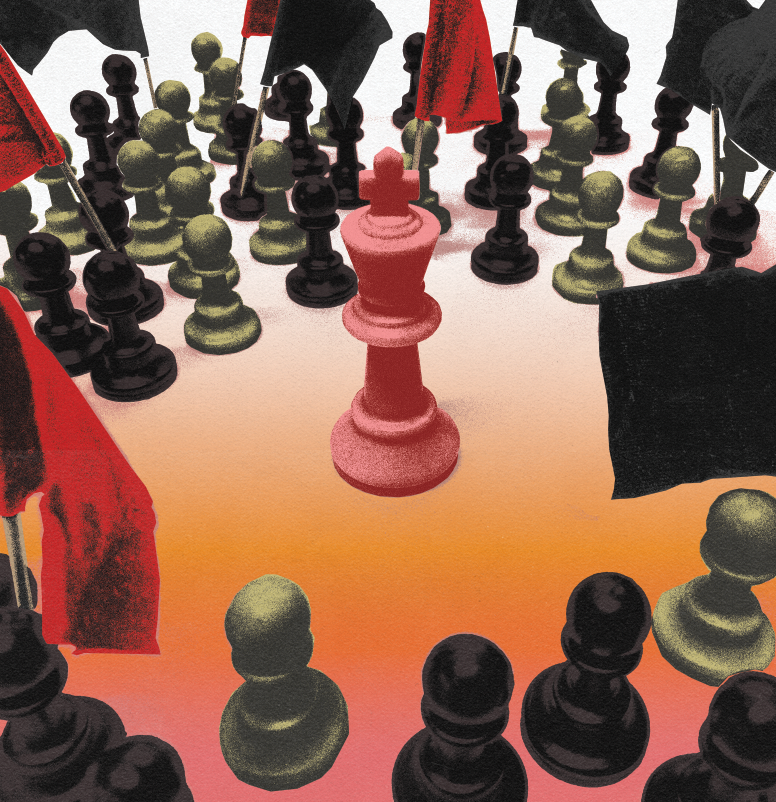
By Heledd Melangell. Illustration: Rory Robertson-Shaw.
Class is a touchy subject. It’s a lens we use to judge others and ourselves. Over the last 50 years, categories of class have become increasingly blurred by neoliberalism, despite Victorian-era poverty making a comeback. We are forever sold the dream of social mobility, but these days, most of the ‘socially mobile’ are hurtling downwards.
Austerity has played a part in this. Families and friendship networks have been financially and energetically trying to care for those around us after years of health and social services being defunded, a burden that left many of us unable to accumulate our own personal safety nets. Many of us have had to move to big cities for work, and the precarity of the housing crisis has been another boot on our necks. At the same time, we watch through black mirrors those with more money than we have ‘living their best life’ on social media, taunting us with pleasures we will never be able to afford.
This disorientation turns to anger. The right has appropriated the language of class and has used it to turn the people against intellectualism, saying it’s not part of our working-class identity; that it belongs to the elites who oppress us. In some ways, this is understandable. As the political theorist David Graeber said, it’s relatively easy for a working-class parent to imagine their child’s future prosperity emerging from starting a business, but it's next to impossible to imagine their kids becoming writers or artists. The amount of nepotism, unpaid labour, and cultural capital needed to start a career of culture creation, among other sectors, is prohibitive to those who are just scraping by.
Our cultural landscape is shaped by people who grew up on another planet to us, which adds to the pervasive feeling of alienation running through society. Alienation from this cultural disconnect makes easy pickings for the cult of Reform and the far right.
I believe that many of us in these strange times feel an incoherent melange of class makeup—culturally, economically, in terms of ownership (or lack thereof), as we deal with constant whiplash from establishing a small amount of stability one week to being thrown into chaos the next. An illness, an eviction, being sacked, or just not getting hours in our zero-hour contract could bring everything crashing down on us.

Who are we? Knowing that we are all part of ‘the 99%’, in opposition to the few billionaires that control everything, doesn’t satiate the disorientation of not knowing where we belong in this newly arranged system. We are not factory workers, nor miners, but neither are we the capitalists. Has the disappearance of the old duality left us politically unmoored?
Yanis Varoufakis, the economist and author of Techno Feudalism, reckons we are in a new stage, and that we’ve reverted to a type of feudalism based on ‘cloud capital’. We are all cloud serfs and cloud proles, with every second of our attention and our personal information steered towards advertising and marketing revenue.
Be that as it may, we are no closer to understanding how to create a collective political identity that holds us together while acknowledging our differences. The chasm of difference between those using food banks and those working for the organs of the state or corporations feels insurmountable. The ghettoisation of poverty, which means those better off are geographically more removed from those living in poverty, can make the ‘problem’ conveniently invisible for many with the power, leisure time, and capacity to speak up in society.
In Wales, where I live, one in three children lives in poverty—how do we square this with the careers of flaunting indulgence and selfishness we see catalogued on social media?
It would be easy to cast moral judgments on those who seem to be doing quite well in the current system. We must accept that some, regardless of background, have accepted bribes from capital and are helping to manage this exploitative system in exchange for their own individual stability. Are these people class traitors, or does that miss the point?
The Openly Classist Collective, in their book The Enemy is Middle Class, draws our attention to this fundamental contradiction between taking on middle class roles that manage the working class in society on behalf of capital, while also being—in name at least—against the capitalist system themselves.
Others, such as Hadas Weiss in her book We Have Never Been Middle Class, agree with the problem of the replication of capitalism by the middle class, but see this class more as victims living in self-disgust at sacrificing the morals of solidarity. When you have caring responsibilities, it can feel as if your energy, efforts and resources are being endlessly torn between the struggle and the needs of your kids, elderly, or disabled loved ones.
Community always seems to come back as the basic building block, easy to ignore, especially by those tempted to turn activism into an individual endeavour for clout, or even future careers.
Class is at an uneasy crossroads. Many of us have swallowed the right-wing media spin that educating ourselves is class treachery. Without understanding the system that makes life a misery for many, how are we to change it?
Are the middle class friends or enemies of liberatory social change from below? Perhaps that boils down to all the many ways it’s possible to subvert the system, and the choices we make every day.
Heledd Melangell is a perpetually confused class war anarchist writing her issues into essays until life starts to make sense once again (for a bit).
Each issue we print 40,000 copies, worth £120,000 to our vendors. Your £3/month subscription is used to print 30 copies per issue, worth £90 for our vendors. We went from 1000 copies per issue in 2018 to 40,000 per issue in 2026. The only thing stopping us from doing more is money. With your support, we can go even further. Help us print and distribute more copies for free to anyone who wants to sell it by becoming a monthly subscriber.