
Another way to live: Inside the fight for Prosfygika
By Zoe Peillon. Illustration by Rory Robertson-Shaw
On 5 February, 2026, Aristotelis Chantzis began a hunger strike to the death to defend his home from the latest development attempt that would result in the violent eviction of over 400 people. The next attack is imminent.
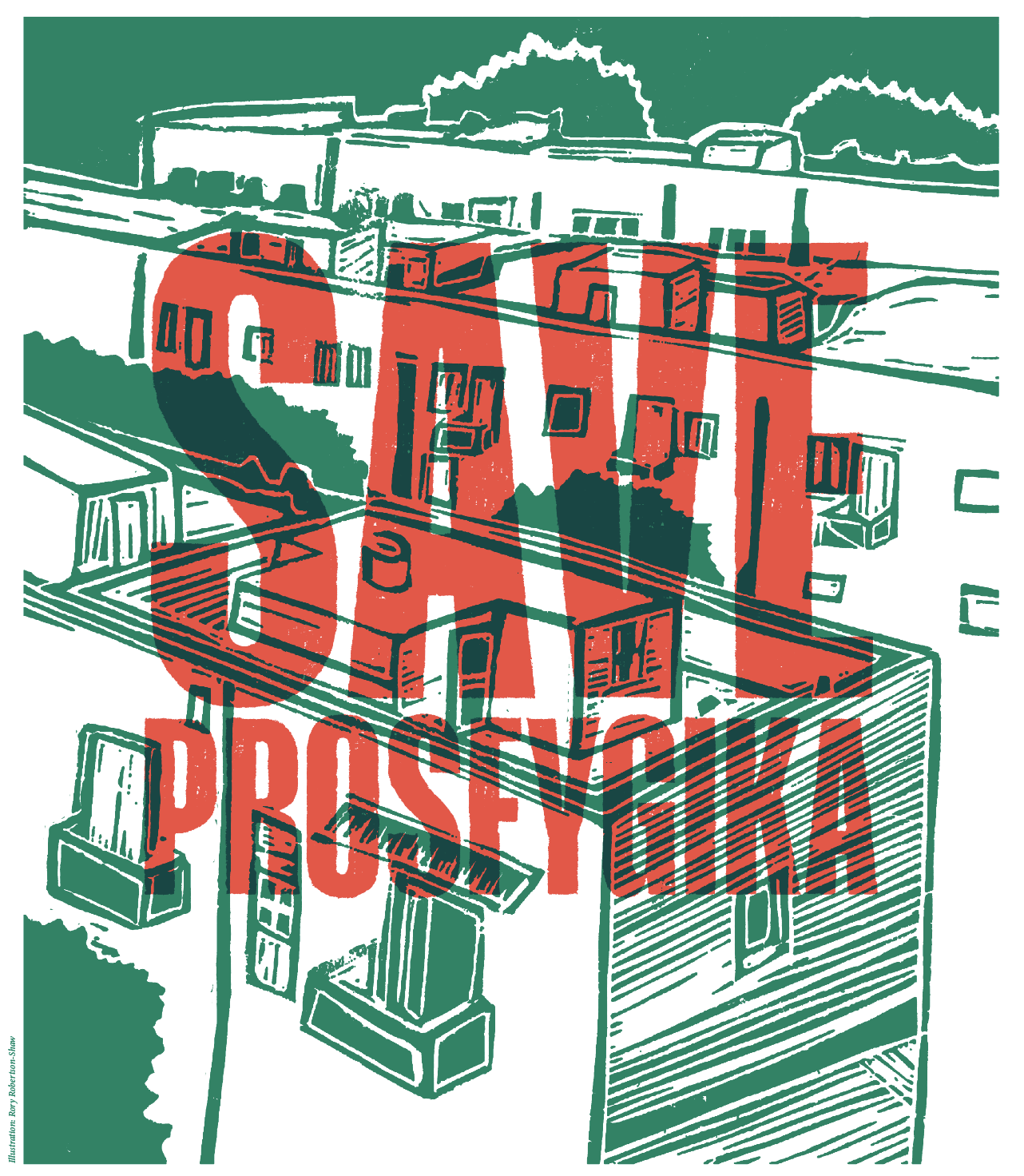
Surrounded on either side by the police headquarters of Athens and the supreme court – two pillars of state power – the eight housing blocks that make up the squatted community of Prosfygika stand proud and unflinching – and always threatened. The neighbourhood is marked by a long history, both as a haven for refugees in Athens since the 1930s (Prosfygika means 'refugee homes' in Greek) and as a stronghold of partisan resistance in the December 1944 uprising, which left the blocks scarred by bullet holes. Today, the neighbourhood plays a key role in the fight against the ongoing state-backed gentrification of Athens.
For most of the residents, living in Prosfygika is not a choice. It is imposed by the realities of housing in the city, which forces people without homes to squat. Many residents have lived in the neighbourhood all their lives, always on the brink of eviction. But they choose to live there on their own terms.
In 2010, the residents of Prosfygika formed the Assembly of the Squatted Community of Prosfygika and dedicated themselves to a political project based on ‘the communal ownership of resources, structures and infrastructures'. They retook control of their own neighbourhood, which had been taken over by drugs and organised crime. Slowly, they turned the neighbourhood into a thriving community united by ‘a common political project, a common political culture and a common perspective’. This requires carefully thought-out systems.
The community, home to over 400 people, including 50 children, from over 27 nationalities, organises itself through a system of structures. The basic and most important tool of this system is the weekly general assembly, which is the main decision-making body alongside the women’s structure. It can take upwards of six hours and includes translation into multiple languages. At the assembly, people can raise issues, suggest changes, and debate their differences. It is a form of direct democracy, where decisions affecting daily life are made collectively.
In the words of one community member, 'We cannot talk about revolutionary plans just by fighting against stuff and destroying; instead, we should fight to create and build. These structures offer answers to the needs of the people who live in the community, but they also exist to offer an alternative to the sick capitalist system. We try to solve problems collectively with the community, not individually'.
From the general assembly, 22 self-organised structures have emerged, open to anyone who wants to participate. Alongside a cinema structure, a social centre, and key infrastructure projects, some notable examples include
The bakery, one of the oldest structures, has been producing bread and pastries daily for residents and the surrounding area since 2013.
The Women’s Structure, a decision-making body and emergency shelter, aimed at building a culture that brings women together and challenges patriarchy.
The Children’s Structure, including a children’s house and self-organised nursery, where children participate in a children’s assembly and help shape their environment; for example, they proposed a playground, which was then built by the community. They are treated as equals to adults.
The Health Structure, which provides healthcare in collaboration with medical groups across Athens. Together with the workers’ union at the nearby cancer hospital, two flats were renovated to house relatives of patients, many of whom previously slept in their cars when visiting the hospital.
So why is the community subjected to regular police raids, tear gas, and arrests — including of minors?
The answer is land and money. Prosfygika sits on valuable land in the centre of Athens. For decades, there have been attempts to demolish the listed Bauhaus buildings. The latest plan involves €15 million in European funding to build social housing as well as accommodation for hospital patients and their relatives.
But Prosfygika already provides social housing. It houses hundreds of people — children, migrants, elderly residents, people with mental health issues, as well as hospital patients and their families. The proposed project would force over 400 people onto the streets, at a time when the community is renovating the ageing buildings themselves, without a drop of public money.
Destroying existing social housing to build new social housing, while 80,000 empty homes owned by the Municipality of Athens sit unused, is absurd. It fits into a broader pattern of gentrification, which aims to move wealthier residents into working-class neighbourhoods and push people who can’t afford exorbitant rents further and further out of the city.
But Prosfygika is not only a fight over buildings. It is a fight over imagination.
We are taught that capitalism, the system we live under, may be unfair, but that there is no alternative. Prosfygika contradicts this idea. It shows that people can organise housing, healthcare, childcare and decision-making collectively. A constant everyday practice of experimentation, by no means perfect, it nevertheless shows that a different reality is possible.
“We do not see our project as an 'island of freedom', nor do we have such illusions”, the members write. As well as offering its structures to the wider community of Athens, the neighbourhood works directly with workers’ unions and self-organised groups to resist the social and economic conditions forced on us, which plunge countless people into poverty. It’s part of an ecosystem of practical, democratic alternatives that allow us to question the system we live in. That experimentation should be allowed to take place.
On 31 January, 2026, 50,000 people took to the streets of Turin in the middle of winter to protest the forced closure of the social centre Askatasuna. People depend on their social centres, and when these places are threatened, they defend them — with their time, their energy, and their bodies. Prosfygika, one of the largest squatted communities in Europe, is no different.
Zoe Peillon is a writer based in Bulgaria. Supporters are calling for public attention and solidarity. If you are interested, you can find out more at saveprosfygika.gr/
Each issue we print 40,000 copies, worth £120,000 to our vendors. Your £3/month subscription is used to print 30 copies per issue, worth £90 for our vendors. We went from 1000 copies per issue in 2018 to 40,000 per issue in 2026. The only thing stopping us from doing more is money. With your support, we can go even further. Help us print and distribute more copies for free to anyone who wants to sell it by becoming a monthly subscriber.