
Organising in the arts
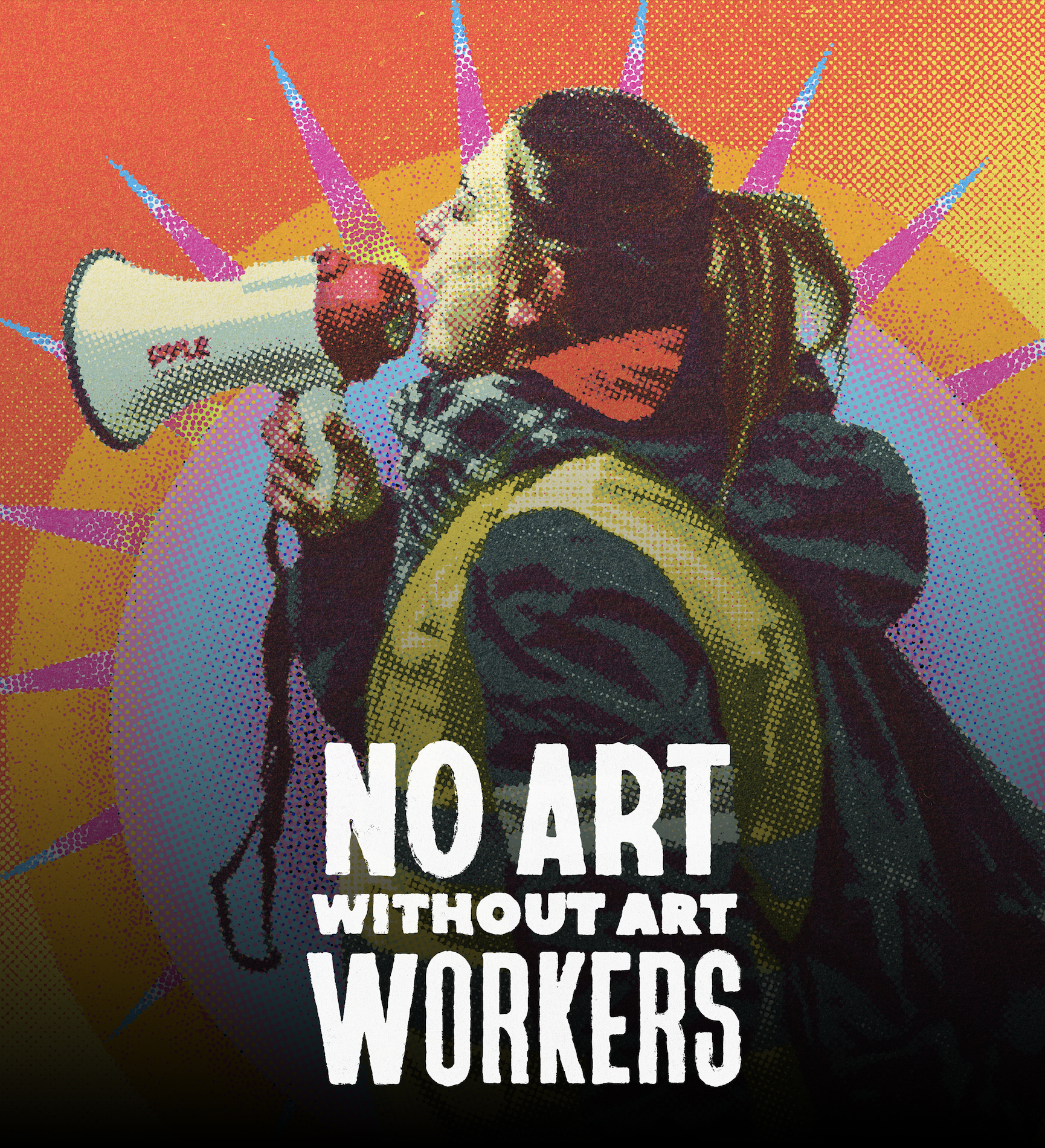
By Dante Philp. Illustration by Rory Robertson-Shaw.
“No art without art work-ers!” might not have rolled off the tongue, but an abundance of rhythm and improvisational skill amongst assembled workers, artists, students and activists outside the Tate Britain late last year ensured the truth of the chant was powerfully felt. Huddled in the cold, a ‘Palestine Day’ on the picket line expressed the strength of feeling shared by culture workers across the country. Out on strike for over a week, rage had built against disappearing wages & pensions, mouldy vending machine sandwiches in place of a subsidised canteen, and their employer’s continued relations with companies embedded in the ongoing genocide in Palestine.
Culture cannot be separated from crisis and calamity. The need to expropriate the little that seems of value, tear down the rest, and build it all anew increasingly seems the only sensible starting point. This cannot, however, just be imagined into being, or straightforwardly prefigured in the present. We can produce culture differently, but not without a fight. Britain’s economy is deeply stagnant and, as recent promises of major state investment make clear, the ‘creative’ industries are primarily valued for their promise of profitable (if mythic) ‘innovation’ that can prop up ‘national pride’. After long-term decline and neglect, a challenge for workers now is to sabotage these reactionary framings and, instead, continue to engage and create new audiences and communities for whom culture is more than just a narrow means of accumulating wealth and stabilising governance. The picket line and the protest, however small, are spaces where different constituencies can gather to share this spirit of antagonism and fracture the top-down systems of arts and culture.
April saw a walk-out of workers at Camden’s Shaw Theatre, as they refused to staff an event booked by Technion, a university deeply tied into research and production for Israel’s arms industry that continues developing ever-increasingly brutal means to terrorise the surrounding region (just as workers had done at the Apollo Theatre in 2024). A few months earlier, directly over the road, striking staff at the British Library had seen the fall of their director, as the ‘leadership’ of the sector continues to reveal that it is all out of ideas. Though institutional bosses may continue to secure funding from global oil and tech companies, it is with the workers who are forging ahead through the contradictions of working in a landscape so conditioned by these corporate interests that we see a meaningful claim on the future of cultural life emerging. As I write, workers at the National Coal Mining Museum in Wakefield have successfully ended a strike that lasted over 175 days. They resisted harassment from private security and police who were called down to the picket line, and rejected any offer that would see them disciplined on their return to work. They have now secured a significant pay rise. Bosses had continuously tried to subvert the strike, opening the museum for school visits on regular closure days to keep up the pretence of business as usual, but militant energy remained intact. ‘Official’ culture regularly works to erase histories of resistance, or sell it back to us in ever more disorienting ways, but workers at the museum, many of them ex-miners, have been taking action so that these histories are not sealed and forgotten, but instead are shown to be always present, ready to be drawn out and extended into the future.
The costs of culture are largely borne by precarious workers, who have to contort themselves to take on jobs in a bewildering market that draws them in and spits them out. Even in highly profitable sectors, severe repression and blacklisting remain constant threats. In October, after a year of increasing redundancies in the games industry (with more than 400 workers estimated to have lost their jobs), over 30 employees were fired from Rockstar Games, all of them members of the Independent Workers’ Union of Great Britain’s Game Workers Branch. In response, there was widespread international mobilisation in support of these workers and against union-busting efforts, with demonstrations from Edinburgh to New York, as workers saw this as a fight for the sector's future. General despair at the roll-out of AI into the production and design of media, for example, must be overcome by direct confrontation with companies using these tools, and it is these workers coordinating around the world who present the strongest front against the expansion of automation into every image, sound and work of art.
That we can see an uptick in these struggles simultaneously is vital, and speaks to the need to build relationships of solidarity across contexts so often kept apart, as we try to practically cross the gulf between workers isolated in museums, galleries, offices and studios. Ruari Paterson-Achenbach highlighted in DOPE #33 that industrial action in the cultural industries can expand outward to question the very nature of contemporary ‘creativity’, and that sustained communication between artists, activists and workers remains a constant challenge in harnessing this potential. The success of the Tate Strike in securing improved conditions and protections, or the recent victory of workers at the London Museum for better pay, deserves attention as these workers demonstrate that deepening immiseration is not all we can hope for, and that contemporary capitalism has not yet exhausted us of transformative experiences. Alternative models of media, just like DOPE Magazine, play an important role in binding these movements together as they seek to build infrastructures not only for documenting the shape of these disputes, but also to do so in a form that stays true to the radical aspirations of the workers taking action, and their commitment to disrupting the usual systems of lifeless management.
Dante Philp is a researcher and editor. He is a member of Artists and Culture Workers London, a rank-and-file network open to all workers who want to build power in the cultural sector.
Each issue we print 40,000 copies, worth £120,000 to our vendors. Your £3/month subscription is used to print 30 copies per issue, worth £90 for our vendors. We went from 1000 copies per issue in 2018 to 40,000 per issue in 2026. The only thing stopping us from doing more is money. With your support, we can go even further. Help us print and distribute more copies for free to anyone who wants to sell it by becoming a monthly subscriber.