
Disappearing act!
The Vagrancy Act is dead, but hostile architecture, dispersal orders and the new Crime and Policing Act mean rough sleepers are still being pushed out of sight.
Outside a department store on London’s Tottenham Court Road, a few awkwardly placed planters are huddled, hidden under the overhanging first floor of the store, which acts as an awning, sheltering a strip of pavement below. The planters contain some useless, dried-up soil. The shelter they sit under used to be home to around ten or so rough sleepers, providing them with a safe place to rest their heads and avoid the burning heat of the sun’s rays. Earlier in the summer, they were all moved on, reportedly at the behest of the police and the local authority, at next to no notice, and at least one of the group has lost all contact with the outreach teams that work the area. It isn’t clear whether they are safe, whether they are alive.
On a morning outreach a few months ago in central London, the amount of alcoves, nooks and spare pavement space arbitrarily cordoned off or occupied by a cone was striking. A seasoned member of the team explained that the sole purpose of this equipment was to deter people from sitting there.
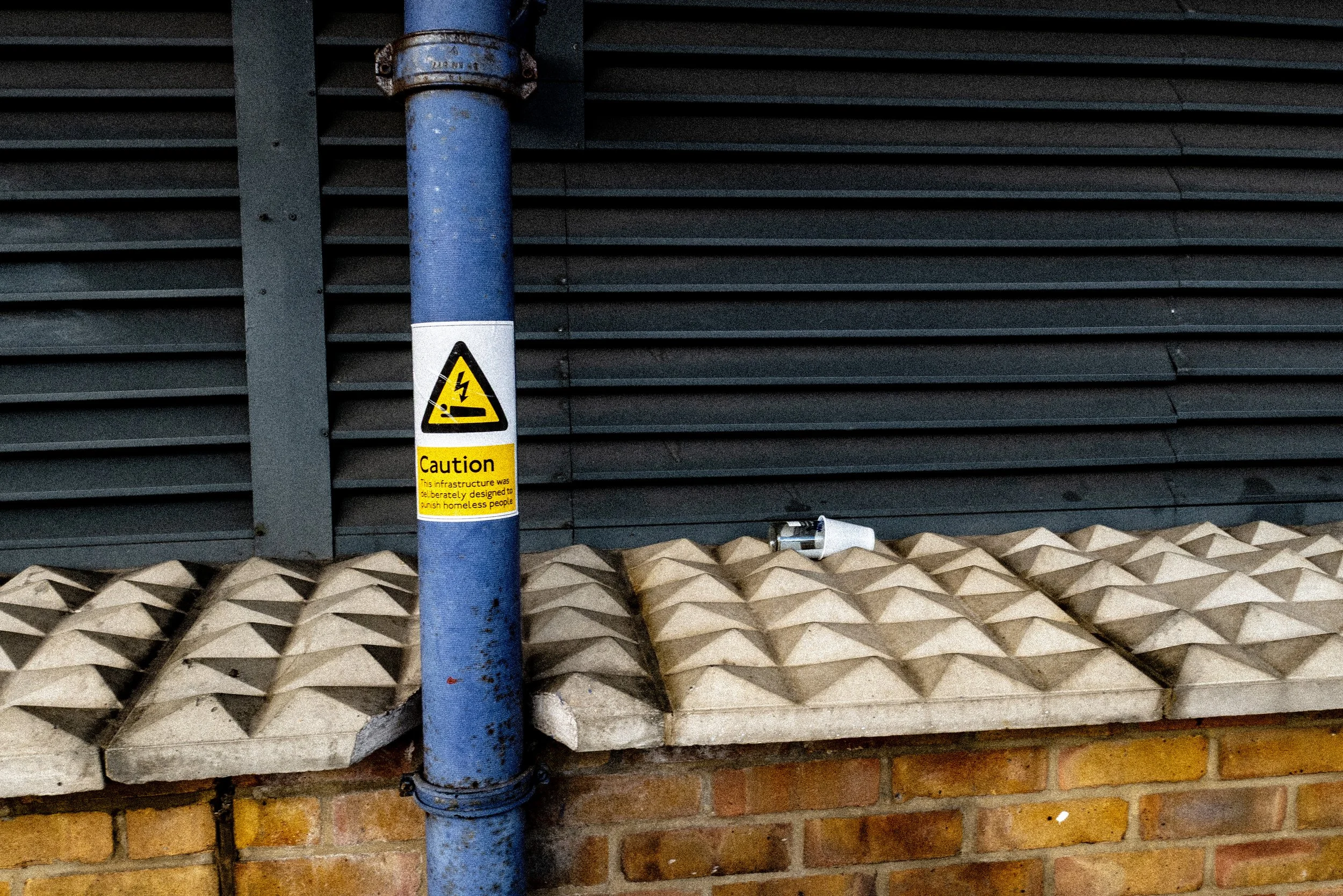
These are a couple of examples from a single morning’s stroll of a hostile approach in attitude and architecture towards people sleeping rough. Once noticed, the callousness of the city’s physical characteristics is impossible to ignore. Benches divided by ugly, uncomfortable armrests, expanses of what should be smooth surfaces rendered uneven by spikes, stones, or jagged brickwork: all denying people a half-comfortable space to sit or sleep. The list goes on.
If you do manage to navigate the unwelcoming architecture and find a place to rest, your troubles don’t end there. The law has been used against people experiencing homelessness for centuries, and legislation is used constantly today to move people along and exclude them from spaces.
The Vagrancy Act was passed in 1824 to deal with the burgeoning number of homeless troops returning from the war in France. The bill criminalised homelessness, arming authorities with powers to move on, fine and even arrest people sleeping rough. Upwards of 3,800 people were arrested under the act in England and Wales from 2018 to 2022.
Apart from the punitive side of the bill, with people fined up to £1,000, the Vagrancy Act encouraged people experiencing homelessness to keep a low profile, effectively pushing them away from the services they desperately needed to survive.
On a Monday morning in late June, the Georgian-era Vagrancy Act was finally, suddenly repealed. Charities and politicians cheered the act’s demise, as jubilant press releases and official responses arrived in email inboxes up and down the land.
But the celebrations didn’t extend to the streets, where legislation and police powers will continue to be used against homeless people. The Vagrancy Act was being used right up to its retirement, and a host of other tools are also regularly used to punish people sleeping rough. Dispersal orders such as Public Spaces Protection Orders (PSPO) and Community Protection Notices are regularly issued by local authorities trying to remove people from public spaces.
At an impromptu picnic in July with Phil, who sleeps in the local park and spends his days outside Tesco, helping shoppers with their trolleys and carrying shopping bags for change, we got to talking about the Vagrancy Act. Not only had Phil not heard that it had been repealed, but he never knew it existed in the first place. He’s been homeless for many years, so of course, he’s been aware for a long time that the police can fuck with him. He’s a bright guy, so when he says he doesn’t need to know his rights because the police do what they want anyway, the tendency is to believe him.
Of course, he’s had his fair share of run-ins with the police, and some of the stories he’s shared are shocking in their brutality and flagrant abuse of his rights. A bleak understanding has been drawn from long, traumatic experience: “I know how to avoid em”, Phil says, “I’ve got eyes in the back of my head. This act [repealing the Vagrancy Act], whatever it is, will make no difference, and the people that most need help, who are a bit unstable, will always be the ones that get grief.”
He isn’t wrong. You can take away the powers of the Vagrancy Act, but there is still a raft of public order-facing legislation that gives police the power to arrest people for next to nothing. There are people on the streets who will continue to run into trouble with the type of police officers who revel in escalation.
The Crime and Policing Act of 2026 has handily replicated many of the powers that the 1824 original Act afforded the authorities. So-called Respect Orders featured in the legislation can lead to rough sleepers being fined, given a criminal record and, eventually, even arrested, simply for trying to sleep in specific zones.
Rough sleepers are also handed dispersal orders to prohibit “spatial trespass”. Under the 2014 Crime and Policing Act, Anti-Social Behaviour Injunctions are handed to people for rough sleeping. Meanwhile, PSPOs can often carry punitive fines of £100, which, going unpaid, can balloon to court fines of up to £1,000. Somehow, all of this makes perfect sense to the people charged with designing legislation and enforcing it.
The awful reality is that the type of trauma-informed training that would help officers when talking to the homeless community is, by and large, only received when it is mandated as a punishment for brutalising someone. It’s like forcing criminal offenders to go to N.A. meetings – it just won’t work.
All the legislation in the world is useless without the skills to apply those laws effectively, but saying that, a decent legal framework is an essential starting point.
Much like the country’s architecture, laws all too often trespass on the lives of people experiencing homelessness. Authorities appear more interested in a disappearing act than in introducing legislation and support that actually helps people. The criminalisation of homelessness goes on.
Mat Amp is deputy editor of the Pavement magazine. He writes about the lived experience of homelessness, substance use and many other topics, including the '90s rave scene.
Jake Cudsi is editor of the Pavement, a free magazine for homeless people in the UK. The publication pushes to platform and promote the voices of people with lived experience of homelessness, as well as inform and entertain readers with news, views and cartoons.
While you’re here- would you consider subscribing? Each quarter we print 50,000 copies, and our vendors keep 100% of the money from sales, meaning DOPE Magazine existing puts around £600,000 into the hands of our homeless vendors each year.
For every £1 put into the organisation through subscriptions, we turn this into £12 for our vendors. This means a year’s subscription to DOPE Magazine at £3 a month makes our vendors £432.
All funded by our community of subscribers.