
The art strike
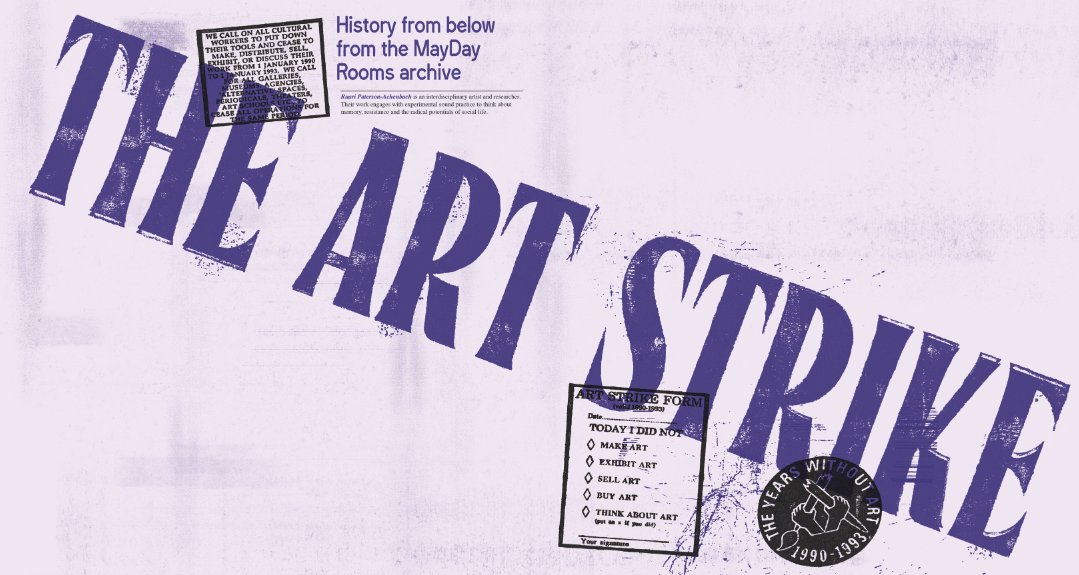
‘We call on all cultural workers to put down their tools and cease to make, distribute, sell, exhibit, or discuss their work from January 1st 1990, to January 1st 1993'. So begins the Art Strike Handbook, published in 1989, with the hopes of initiating an international cessation of artistic labour. Organisations were formed, banners and badges were made, and pickets were organised. The goal wasn't just to shut down the art world, but threaten the very notion of art itself.
Since the concept of an art strike was first advocated by French writer, poet, and artist Alain Jouffroy in his 1968 essay What's To Be Done About Art?, the idea has evolved in both concept and action. For instance, while the Black Emergency Cultural Coalition (BECC) boycotted artistic institutions in New York during the ‘60s and ‘70s over their racist omissions, the Art Workers Coalition (AWC) shut down multiple galleries and institutions for one day in protest against the Vietnam War. These actions show that revoking artistic labour and participation can be an effective way to highlight their importance. In a more individual example, in February 1969, conceptual artist Lee Lozano began General Strike Piece, a long-term performance that involved her withdrawal from the New York art world and her promise to ‘exhibit in public only pieces which further sharing of ideas and information related to total personal and public revolution’.
Still, the most ambitious and concrete conception of the art strike arrived in 1974 with stateless artist Gustav Metzger’s Years Without Art: a call for the revocation of all artistic labour for a minimum of three years, something he personally followed through on between 1977 and 1980. While both the BECC and AWC organised ‘counter-biennales’ to the institutions they targeted, continuing artistic production in what they viewed as the ‘right’ way, Metzger’s call was for a more radical approach. He viewed even artistic production in the service of social change as reformist, seeking to improve the current conditions of the art world rather than completely altering (or abolishing) it. Instead, he called for complete withdrawal.
Metzger was particularly wary of the co-optation of artistic work by the state. ‘The state supports art, it needs art as a cosmetic cloak to its horrifying reality, and uses art to confuse, divert, and entertain large numbers of people.’ During the ‘Years Without Art’, which would surely result in the destruction of numerous institutions, Metzger advocated for using the time to think about what kind of artistic world we might want to build. He took the opportunity to get involved with subversive activity and undertake artistic research. Despite not using the term ‘art strike’, Metzger’s radical call has become synonymous with it.
Metzger’s initiative turned out to be only a solo effort, but it inspired the episode that started this article: the 1990-1993 art strike. Initiated by a group of culture workers under the banner of ‘PRAXIS’, the art strike was first called in 1985 and, in 1986, extended to a general ‘refusal of creativity’. Spread through various pamphlets, flyers, and articles in Smile magazine, the strike immediately gained support, with Art Strike Action Committees (ASAC) cropping up in Britain, the U.S.A., Ireland, and across Latin America.
The focus of the strike’s attack was the elitist and exploitative nature of the art world, localised in galleries, dealers and an ever-decreasing presence of government funding. But beyond this, the strike sought to attack the notion of art itself—specifically, the conditions and processes through which certain forms of ‘acceptable’ creativity are legitimised as artworks by the ruling class. The aim (or at least the more ‘practical’ version of it) was not the complete destruction of the art world (not enough solidarity or class consciousness existed among artists to make such an act possible), but rather to expose its unsustainable flaws and contradictions. By contesting the terrain of art itself, new possibilities open up for both creative practice and class consciousness.
Sadly, despite widespread international support, only a handful of artists committed to striking for the full three years. It can be tempting, then, to read this historical moment as a failure. But, as with many forms of industrial and direct action, success does not lie solely in the outcome, but in the ideas it inspires. To treat artistic work as labour is to both insist upon its social necessity and to insist that the conditions of making it can be improved. Throughout the various iterations of the art strike, there is a shared recognition that to change (or destroy) the art world, you have to change (or destroy) the very notion of art itself. You have to ask why some works of art are deemed good, innovative or worthwhile, and which people or institutions get to decide this.
Some of the criticisms of the ‘90-’93 strike movement went along the lines of, ‘How can you strike from making things which the vast majority of people don’t even know or care about?’ An additional contemporary question to add might be, ‘What does it mean to revoke artistic labour when numerous corporations are investing inordinate amounts in generative artificial intelligence to render it useless in the first place?’ It can seem, more than ever, that we should be insisting on our right to continue making creative things and to be valued, socially and economically, for doing so.
But baked into the notion of an art strike is the insistence that this continuation of labour should be on the terms of the workers, an idea that has emerged in various locations in recent years. The refusal by musicians to perform in Israel, or for artists to collaborate with Israeli artistic institutions, is one of the most visible elements of the BDS movement. Arguably the most recognisable and successful recent examples of an art strike were the simultaneous strikes by the Writers Guild of America and the American actors' union SAG-AFTRA in 2023. These labour disputes were fought on more traditional grounds, such as wages, pensions, and healthcare, but also included specific demands for regulations on artificial intelligence, including a prohibition on using writing and actors’ likenesses for the training of AI models. The disputes required solidarity between some of the wealthiest and most secure art workers in the world and those most precarious and exploited. And, eventually, both unions reached agreements on their demands. Combining these more traditional forms of industrial action with the expansive revolutionary demands of the art strike will be key to enacting radical change in the ways we make and enjoy art.
As the vampiric nature of capital continues to consume ever more viciously and mercilessly, with the increasing support of slop-producing, attention-grabbing technologies, retaining collective autonomy over the production of creative objects will become more important than ever. What the art strike reminds us is that we always have to imagine beyond what is immediately in front of us. Experiencing the process of creativity reminds us that being explorative without demonstrable results, despite capital’s best wishes, is a worthwhile use of time. If we wrestle the very notion of art from the grip of elitist capitalist hegemony, who knows what might be possible.
Ruari Paterson-Achenbach is an interdisciplinary artist and researcher. Their work engages with experimental sound practice to think about memory, resistance and the radical potentials of social life.
Each issue we print 40,000 copies, worth £120,000 to our vendors. Your £3/month subscription is used to print 30 copies per issue, worth £90 for our vendors. We went from 1000 copies per issue in 2018 to 40,000 per issue in 2026. The only thing stopping us from doing more is money. With your support, we can go even further. Help us print and distribute more copies for free to anyone who wants to sell it by becoming a monthly subscriber.