
Signs of Rebellion
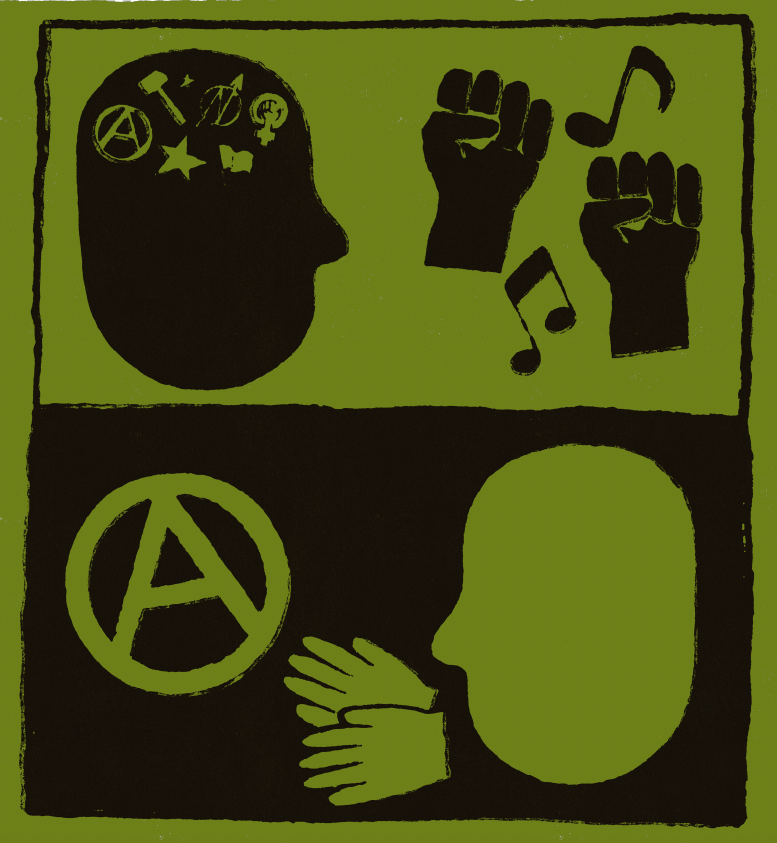
By Dai and Steve. Illustration by Rory Robertson-Shaw.
As we write, the world is on fire. Trump threatens Greenland and Venezuela, Iranians are being killed for protesting against their regime and the Gaza genocide continues. Climate breakdown is quickly entering a critical period. There is a desperate need to shift towards peace and reconstruction, and ideas for how to do so without relying on the state, government, or political parties are becoming increasingly popular. But those ideas are not equally accessible for all. As deaf people who use British Sign Language (BSL) as our first language, we face barriers that prevent us from participating in these discourses of resistance.
Means of resisting war and oppression locally and internationally have interested us since our teens, and this interest has drawn us to the anarchist movement over the last 20 years. In 2022, we discovered the writings of a deaf anarchist, Leonard A. Motler, who was an anarchist-communist active in the UK from around 1910 to 1925. We undertook in-depth research, which resulted in a journal article, presentations on Motler, setting up the website deafanarchy.com, and the Radical Signs project.
The Radical Signs project aims to find ways to make information about radical politics, including anarchist politics, more accessible to signing deaf people. We have done this in numerous ways, including creating political BSL vocabulary, translating political texts, and collecting biographies of deaf people involved in radical politics.
According to the British Deaf Association (BDA), 150,000 people use BSL daily. This makes it the fourth-largest indigenous language of the UK, behind English, Welsh, and Scots Gaelic. The language was legally recognised in 2022 with the BSL Act, which came about as a result of grassroots activism from 1998-2004 with direct action, pressuring MPs, lobbying and campaigning.
Sign Language and deaf culture, or Deafhood, has survived despite decades of suppression by the medical profession since the 18th century. Over time, the oral method of instruction - trying to teach children through speech - has become the default mode, specifically gaining traction after an unrepresentative congress in Milan in 1880 (only 4 delegates were deaf) claimed oralism was a superior means. This led to deaf teachers being fired worldwide, and deaf children forced to learn to lipread and speak, even when their natural means of expression was in sign language.
This suppression has not been without resistance, and deaf people worldwide formed organisations to struggle against prejudice and discrimination against sign language users, including the BDA here in the UK. Deaf people have, in this resistance, developed a diverse range of cultural practices, from poetry, theatre, television, art, and sports, to particular values such as collective community activities at deaf clubs, spaces, and events.
However, one area in which deaf people still struggle for access is radical politics. While parliamentary politics are sometimes interpreted into BSL on the TV news, small radical non-institutional political groups often do not have the funds to pay for BSL translations of their principles and actions, which means that deaf people are often unaware that there is a world of alternative politics beyond the tired and archaic systems of parliamentary politics.
Deaf people may therefore be familiar with mainstream political signs such as those used for the main parliamentary parties, but are less likely to be familiar with radical signs. The raised fist, for example, can refer to anything from rebel to radical to socialist to communist, and many other concepts in between. The sign for anarchism might be portrayed as the same as the sign for chaos or damage, which obviously misrepresents the term, leaving us back at the raised fist representing anarchism. Without the vocabulary to discuss radical concepts, how can deaf people access alternatives?
To this end, we set up two Radical Signs workshops in central London, consisting of deaf people both familiar with political activism and knowledgeable in sign language, plus hearing people who are engaged and active in the anarchist movement and knowledgeable about its politics. We created a list of the most common radical-left terms for translation at each workshop. We discussed each one as a group and reached consensus on the sign, or signs, that best reflected the term's meaning. Often, there were more than one sign, in which case all relevant ones were agreed on. Once agreed, we recorded the sign in BSL, and also included a short description of why that sign was chosen.
We then set up the deafanarchy.com website, with help from The Lipman-Miliband trust. This enables us to host videos of the signs and the rationale for their use. It’s a public website, meaning anybody can access the signs. The signs are useful not only for deaf people, but also for interpreters and radical activists. Effective political discussion about anarchism and radical left politics is limited without the signs as it is difficult to convey and understand many terms without them. We hope that now these signs are out there, they will stimulate discussion within the community, both about the signs themselves, and about how radical politics can contribute to deaf communities, and vice versa.
Politics shouldn’t be confined to the language of political parties and parliament since there is a rich tradition of political activity that takes place outside these formalised, rigid structures. Societal change through radical action - be that local, regional, national, or specific to a group - need not be confined to lobbying MPs, becoming involved in a formal political party, or campaigning for state-based reforms. There are actions that can take place outside of these arenas which may be more practical for those who want to get involved. With radical signs, we can discuss and explore these methods and ideas within the very movements where it all happens.
Dai is deaf and works as an Associate Professor of BSL and Deaf Studies in York St John University.
Steve is deaf and is currently working on a number of projects in the field of sign language and Deaf culture.
Each issue we print 40,000 copies, worth £120,000 to our vendors. Your £3/month subscription is used to print 30 copies per issue, worth £90 for our vendors. We went from 1000 copies per issue in 2018 to 40,000 per issue in 2026. The only thing stopping us from doing more is money. With your support, we can go even further. Help us print and distribute more copies for free to anyone who wants to sell it by becoming a monthly subscriber.